


A showman powers up a robot, which then grows out of control and attacks him. It’s a familiar theme, perhaps the plot of any number of 20th and 21st-century robot tales, but this one is from 1897.
We’ve been obsessed with humanoid robots for a long time, more than a century in fact. While most credit Czech writer Karel Čapek with coining the term “robot” in 1920, we now have evidence of a robot run amok from one of film’s first artists: George Méliès.
Article continues below
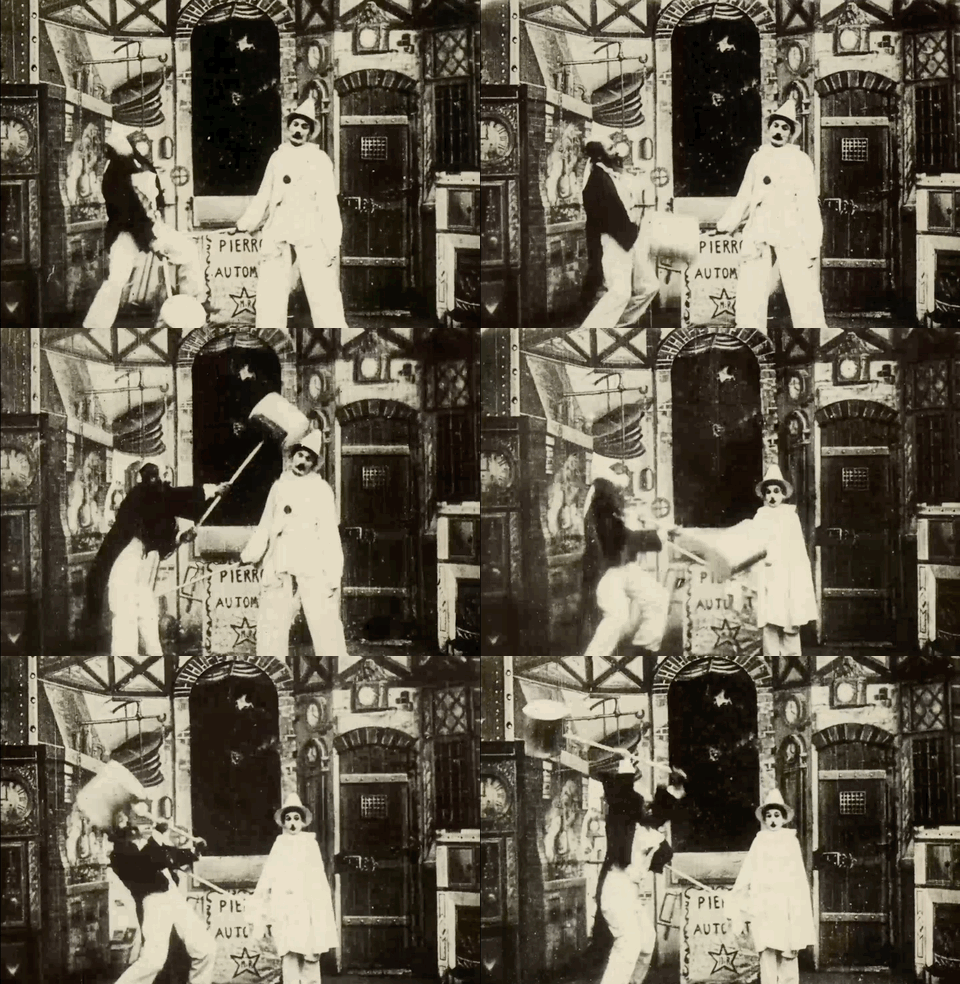
The robot then quickly turns on its owner, whacking him in the head. Naturally, the showman panics, grabs a huge mallet, and whacks the robot back through its growth spurts until it’s a child, then what appears to be a small statue, which the showman smashes (or it vanishes; it’s hard to tell).
Okay, it’s a fairly thin story, but what do you expect in 45 seconds? I’d argue the original story is a bit more fascinating. The previously thought lost Méliès’ film (better known for 1989’s The Man in the Moon) showed up at the doorstep of the US National Audio-Visual Conservation Center for the US Library of Congress, which has some expertise in recovering and digitizing nitrate film.
In fact, older nitrate film tends to hold up better than newer, less flammable media like cellulose acetate. The Library of Congress verified the authenticity and quickly realized it was Méliès’ Gugusse and the Automaton.”
The Library of Congress explains the entire saga of how it was found and preserved in an Instagram post.
You can watch the film here.
Considering Méliès made the first and still referenced space movie, I wouldn’t call the multi-hyphenate director anti-science or tech. On the other hand, the science in his Moon film is not exactly Hail Mary-accurate.
It’s also fair to assume Méliès was thinking more about automatons (albeit a super-intelligent one) that were popular in that era. These 19th-century toys used complex gears and pocket-watch-level engineering to create an imitation of life.
Still, this idea that an automaton would turn on its maker is the first early inkling we have of a robot uprising, one that is quickly squelched, of course.
There’s obviously no concept of AI, but the automaton in this clip does have some self-determination. After all, it decides to attack its creators.
Now, almost 130 years later, we’re grappling with the very real possibility that AI-powered robots or AI models might do something we don’t expect, or even act in their own self-interests and ones that are at odds with humanity.
Just look at what Anthropic’s unreleased Claude Mythos code just did. As we reported last week, the model exhibited “‘strategic manipulation,’ ‘concealment,’ and other behaviors that didn’t always surface in the model’s responses.'”
In other words, it whacked its creators, and they took a giant hammer to it to shut it down — for now.
Follow TechRadar on Google News and add us as a preferred source to get our expert news, reviews, and opinion in your feeds. Make sure to click the Follow button!
And of course, you can also follow TechRadar on YouTube and TikTok for news, reviews, unboxings in video form, and get regular updates from us on WhatsApp too.

