


It is now more than eight months since the June afternoon in Ahmedabad, western India, when a Boeing 787-8 Dreamliner fell from the sky, crashing down into a busy medical college in one of the world’s worst aviation disasters.
All but one of the 241 people on board the London-bound flight were killed as well as 19 medical students and others on the ground. The dead include 200 Indians, 52 Britons, seven Portuguese nationals and a Canadian. Incredibly, one man survived – Leicester resident Viswashkumar Ramesh, who was thrown clear of the fuselage.
How did this seemingly routine flight end in such devastating circumstances? That’s one of several questions being asked by the families of those killed, and time is running out for India’s aviation authorities to come up with an answer. According to international regulations, crash investigators must provide a final report one year after the incident, which would typically point to a probable cause and provide recommendations on how to avoid it happening again.
The Independent understands that investigators have still not settled on a cause for the crash, but that they are leaning in the direction of either human error or deliberate action by the pilots – rather than any mechanical fault with the plane.
That’s despite a growing number of lawsuits directed at Boeing and Air India, filed by the families in courts in the UK and US, alleging that the plane in question was flawed from the moment it entered service in India.
A preliminary investigation report, released one month after the 12 June crash, has already triggered allegations of an attempt to avoid culpability by pinning the blame on the pilots. The family of one of the two pilots has already moved India’s top court to clear his name after the preliminary report appeared to implicate him.
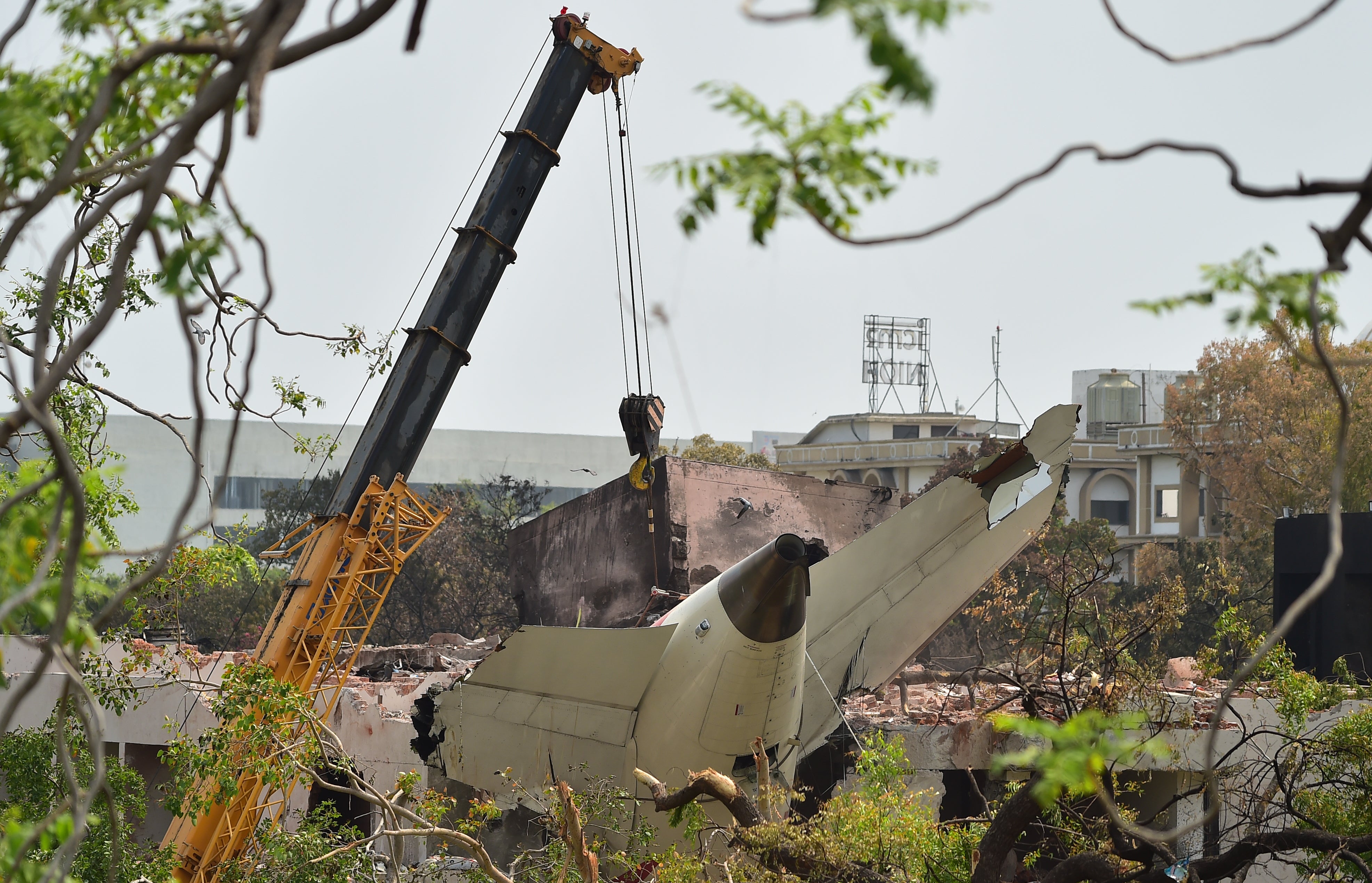
The report, submitted nearly 30 days after the tragedy, stuck to providing the factual sequence of events, stopping short of any causal analysis and leaving deeper questions unanswered. It claimed that three seconds after taking off, both the aircraft’s fuel control switches almost simultaneously flipped from “run” to “cutoff”, starving the engines of fuel.
The plane immediately began to lose thrust and sank. One pilot could be heard on the cockpit voice recorder asking the other why he had cut off the fuel. “The other pilot responded that he did not do so,” the report noted. An auxiliary power unit intended to provide power to the aircraft in the event of engine failure then deployed automatically.
The switches returned to the “run” position after about 10 seconds. It was too late. Moments later, one of the pilots transmitted a “Mayday, Mayday, Mayday” call.
The 15-page preliminary report assigned no blame, identified no cause and didn’t conclude whether the crash was the result of technical failure, human error, maintenance issues, or systemic oversight gaps.
Still, it sparked a media trial of the pilots, first officer Clive Kunder, 32, who was flying, and captain Sumeet Sabharwal, 56, who was observing.
The coverage of Sabharwal, a veteran with 15,638 flying hours, focused on unsubstantiated claims about his mental health, prompting his 91-year-old father Pushkar Raj Sabharwal to ask the Supreme Court of India for an independent investigation into the crash.
The court responded sharply, insisting that there was no basis to blame the captain. “It is extremely unfortunate, this crash, but you should not carry this burden that your son is being blamed,” Justice Surya Kant said. “Nobody can blame him for anything.”
“The preliminary report was a total disaster,” says Amit Singh, the founder of Safety Matters Foundation, an aviation safety education platform, and a party to the family’s application to the Supreme Court.
“The words have been very cleverly chosen that they cannot basically bounce back on them,” he tells The Independent. “But there are certain issues which they should have investigated. And the technical part has given a clean chit. Whereas the report itself says there were so many technical issues. So they are basically playing with people’s psychology.”
The judge’s remarks about the captain came after Air India’s chief executive, Campbell Wilson, emphasised that initial investigations “indicated that there was nothing wrong with the aircraft, the engines or the operation of the airline”.

Still, an Aircraft Accident Investigation Bureau (AAIB) official, who asked not to be named, told The Independent they continued to investigate all possibilities, not just human error. “We haven’t ruled out any probable cause, be it technical or human error,” they said. “However, there seems to be less scope for mechanical fault.”
Other media outlets have quoted sources as saying investigators have all but ruled out mechanical failure or sabotage, leaving pilot action as the strongest line of inquiry. And that’s in keeping with the way the authorities have treated the two pilots’ families.
The Independent learned that AAIB officials visited Sabharwal’s Mumbai home unannounced in August and told the family that the pilot had died by “suicide”. Family members were also asked to appear before investigators, a move aviation experts said violated established rules.
“This hurt me like hell,” the captain’s father told local media outlet Mojo Story. Frail and living alone, the former air traffic controller and ex-official of the aviation regulator DGCA felt compelled to move the Supreme Court to seek justice for his son.
“He was a professional pilot and well-experienced and knew his job very well,” he said.
“I think his colleagues can tell you better than I about what kind of a person he was. He was always calm and quiet. I pray to the almighty that the proceedings should be just and fair and he should get the justice.”
The AAIB also invited a legal notice from the Federation of Indian Pilots after the agency summoned the late pilot’s nephew Varun Anand, a serving Air India pilot, to face the investigators.
“The sole basis for calling Captain Varun Anand appears to be his familial relationship with the deceased pilot-in-command, which is impermissible in law and renders the summoning arbitrary and unsustainable,” the federation said, noting that he was neither a factual witness nor a technical witness nor an expert witness in relation to the crash.
“We’ve realised that the people who should be taking responsibility for the Air India crash are instead trying to put everything on Sumeet,” a member of the pilot’s family told The Telegraph.
“A sustained media campaign was run, first to question his professionalism and then his mental health. It’s sad to see a powerful lobby tarnishing the reputation of Sumeet.”
Independent aviation experts said recent findings pointed to an electrical fault, possibly caused by a water leak, which likely made the lights flicker inside the plane just before the crash, as described by the lone survivor.
“So we’ve figured out what actually happened. We’ve a logical justification, and everything adds up to an electrical failure. Cascading electrical failure,” Singh says, adding that his requests to assist in the investigation met with silence.
According to the Foundation for Aviation Safety, an aviation advocacy group in the US, the Boeing aircraft had a record of technical and electrical failures. It entered service with Air India in 2014 and went on to suffer a series of system failures, including an electrical fire in 2022 which led to the replacement of core system components, the group said in a submission to the US Senate. The issues, it alleged, were caused by “a wide and confusing variety of engineering, manufacturing, quality, and maintenance problems throughout its 11-year life”.
Ed Pierson, the advocacy group’s executive director, linked the aircraft’s history to manufacturing quality concerns around the 787. Pierson described the 787 Dreamliner as an “electrical monster” due to its unprecedented reliance on complex electrical systems to replace traditional pneumatic and hydraulic functions.
He said investigators must thoroughly assess whether cascading system failures played a role in the crash before assigning responsibility to flight crews.
The Dreamliner had faced three electrical failures and 11 minor components malfunctions in the 48 hours before the crash, according to The Federal. Hours prior to the crash, it had even suffered a hard, abnormal descent on its inbound flight due to an issue with one of its flight control systems.
The AAIB report mentioned that the pilots logged a sensor fault but it failed to mention what the maintenance staff logged. According to the maintenance log, the right-side stabiliser-trim electric motor control unit had failed and it had been replaced along with the wiring and stabiliser sensors.
This was also mentioned in the aircraft health monitoring report sent to Boeing and Air India on 12 June 2025.
In the wake of the crash, AAIB investigators went to Washington to check whether the fuel switches had been deliberately moved to “cutoff”, with the National Transportation Safety Board analysing cockpit recordings for tell-tale sounds of manual toggling, unnamed sources told The Wall Street Journal.
“To us, that tends to indicate there is probably something there that needs to be looked at because common sense would tell that if you’ve a conclusive recording that would support the pilot’s suicide narrative then there would be no need to go to Washington to go through the data,” Mike Andrews, an American lawyer representing nearly 130 families of the victims, tells The Independent. “If you already know the answer, why are you still searching for the answer, essentially.”
On the other side, US investigators were allegedly barred from photographing the wreckage in India, some of which had been moved before they could examine it, the Journal reported.
Indian authorities were also accused of sidelining black box analysis in the early stages of the inquiry.
“The procedure is, the minute you get the black box, you are supposed to decode, because it has so much critical information,” Singh notes. “But these black boxes – the first one was recovered on 13 and the second on 16 June – were sitting in Ahmedabad until the 24th.”

As the investigation remains shrouded in mystery, hundreds of bereaved families are left to mourn in the dark, grappling with devastating loss and no answers.
Some families say they can’t bear the sound of aircraft overhead while others find themselves struggling to make ends meet. “There are economic hardships that were not there before because in some cases the primary breadwinner was killed in the crash. So families in some cases have been uprooted, have had to move in order to be able to afford daily living. In some cases, teenage and young adult children have had to drop out of school and go to work to help support the families,” Andrews says.
Loneliness hangs heavy over Anil Ambala Patel, who lost his son Harshit Patel and daughter-in-law Pooja in the crash. Already widowed by his wife’s death from breast cancer, he is now buried under the weight of grief, having lost most of his family.
His son and daughter-in-law had come to visit after two years of moving to the UK in 2023. The couple had married in 2018 and the two families had pooled money to send her for studies at De Montfort University. Harshit had moved to Leicester on a dependent visa.
“Harshit and Pooja said they would return to India in 2027 and settle down here,” Patel tells The Independent. He is now struggling to access the couple’s bank account in Leicester.
In Banaskantha, about 250km from Ahmedabad, Savdhanbhai Chaudhary mourns the death of his son and his daughter-in-law. Kamlesh Chaudhary, 26, who worked in a “fancy goods store”, had been in London since 2022. He had come visiting to take his newlywed bride, Dhapuben Chaudhary, 24, with him.
It was his wife’s first time travelling by air. “Our family and the entire village was so proud of our children that they could make it in London. I miss them a lot. There are no words for our loss. No compensation will ever fill the gap of our children,” Chaudhary says, tears rolling down his eyes.
The last memory of his children is a 30-second video of the couple clearing the security gate on 12 June. In January, Chaudhary travelled five hours to Ahmedabad to receive their half-burnt remains and was told to return later to collect more.
Air India has set up a Family Returns Centre in Ahmedabad for the affected families to collect the belongings of their loved ones. The airline has recovered 22,000 items from the crashed flight. The families have a 45-day window, ending 20 February, to browse an online portal, select images they recognise, place them in a “claim box”, and contact the airline to process their claims — a tedious process for some of the families unfamiliar with technology.
In days after the crash, Air India quickly paid the equivalent of $28,000 to the families of each of the dead. The airline’s owner, Tata Group, pledged to add another $112,000.
Andrews said that while majority of the families received compensation from the Tata Group, some were still awaiting to receive the ex-gratia money from the state government.
In Meghani Nagar, the area near the Ahmedabad airport where the plane crashed, residents say the violence of that day remains etched in their memory.
“The plane was flying unusually low. Before I could understand what was happening, there was thick black smoke and a deafening crash,” Manubhai Rajput, who lives 200 meters from the crash site, told The Times of India. “We never looked up at the sky. But that day is etched in my mind.”
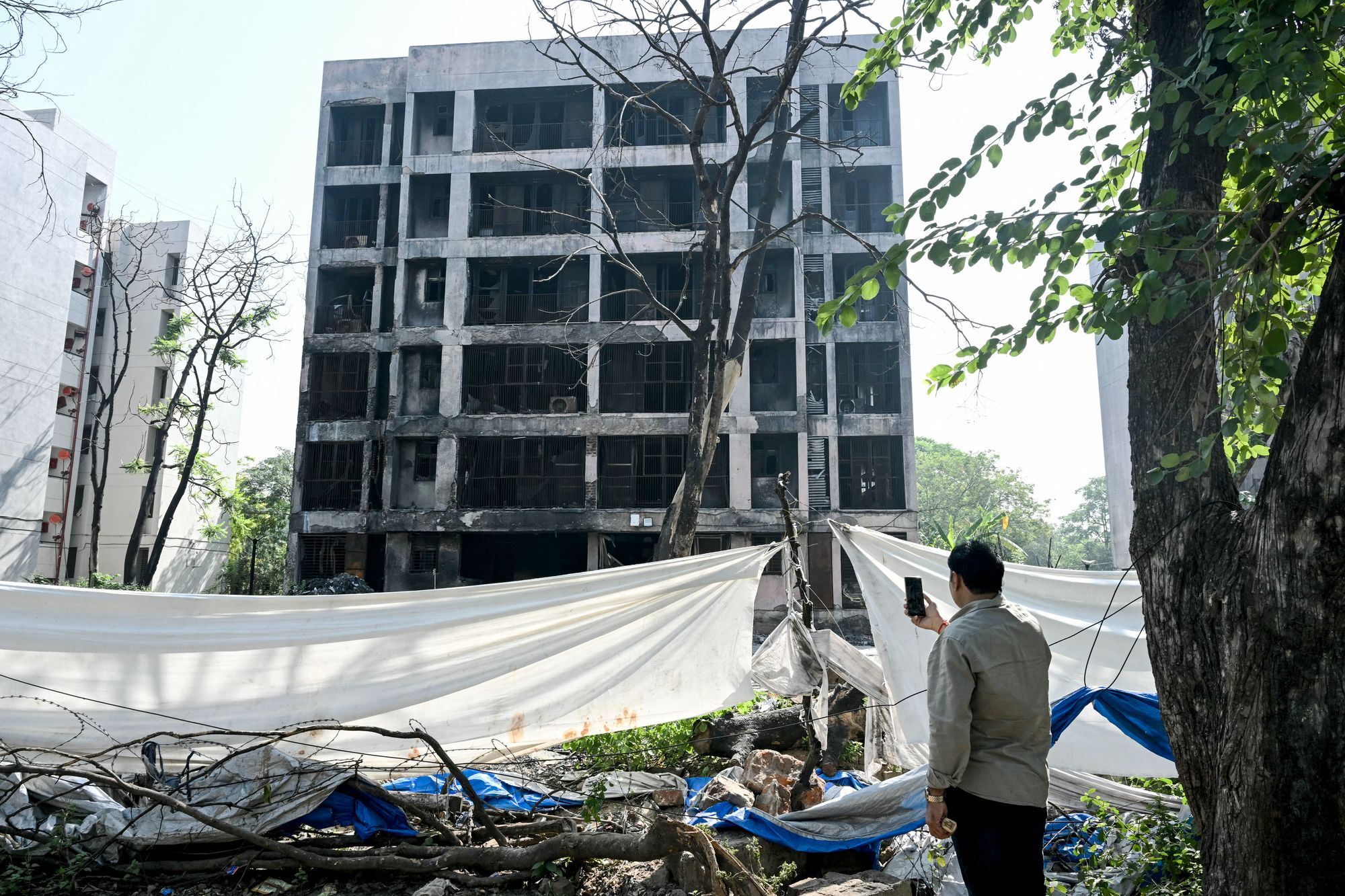
The charred and abandoned hostel building and the adjoining canteen stand as haunted reminders of the disaster.
“The area now lies very silent, only a few birds chirp here,” Sanjaibhai, a security guard tasked with keeping away trespassers, says. While the investigation continues, the area remained off-limits to the public.
Akash Patni, 14, was on his way to deliver food to a relative when the flight crashed, killing him. His mother, Sita Patni, her burn scars a testament to her struggle to save him, says she saw him “burn to ashes” before her eyes.
“I am in pain the whole day. I tried to save him, but he did not survive,” she tells The Independent. “I couldn’t sleep in the house anymore after what happened to my son.”
She can no longer muster the courage to look at planes flying overhead.
Her husband, Sureshbhai, closed the family tea shop after the tragedy and said in January that he planned to move away from the airport and the city. No amount of monetary compensation could “bring back what we have lost”, he said.
.jpg)
In London, several families of the victims have filed a personal injury lawsuit at the London High Court. James Healy-Pratt, an aviation partner at Keystone Law, told The Independent that High Court proceedings had been issued against Air India but not yet formally served.
“This is against the backdrop of upcoming confidential negotiations in London,” he said, referring to settlement talks. “Hopefully, the parties will resolve their claims through such dialogue without the need for a trial in the Kings Bench Division of the London High Court.”
Air India, jointly owned by the Tata Group and Singapore Airlines, is on track to report its largest annual lose ever of Rs 150bn ($1.6bn) for the financial year ending 31 March 2026, according to sources quoted by Bloomberg.
There is talk of Air India searching for a new chief executive to replace Wilson, although the process may not conclude until the final crash report is released, with his term due to end in mid-2027 and reports that he could leave earlier than that unconfirmed.
The Independent approached Air India and Boeing for comment. Air India declined to give an on-record statement, citing the ongoing investigation, while Boeing had not responded at the time of publication.
Wilson, who has visited the site of the crash, previously said investigations “take time” but that the airline “will be fully transparent and we will support the process for as long as it takes… Air India will continue to do everything we can to care for those affected by this tragedy, and to uphold the trust placed in us.”
Boeing’s CEO Kelly Ortberg offered the manufacturers “deepest condolences” to the victims after the crash, and said Boeing “stands ready to support the investigation led by India’s Aircraft Accident Investigation Bureau”. Subsequent media enquiries to Boeing have been directed to the AAIB.
While some families have been offered final compensation packages by Air India, and others continue to keep their legal options open, for all those involved the next big date on the horizon is 12 June 2026, when the UN aviation watchdog’s rules stipulate that the authorities must provide either their final report, or a comprehensive update explaining any further delays and their findings so far. Whether that provides any closure remains to be seen.

