


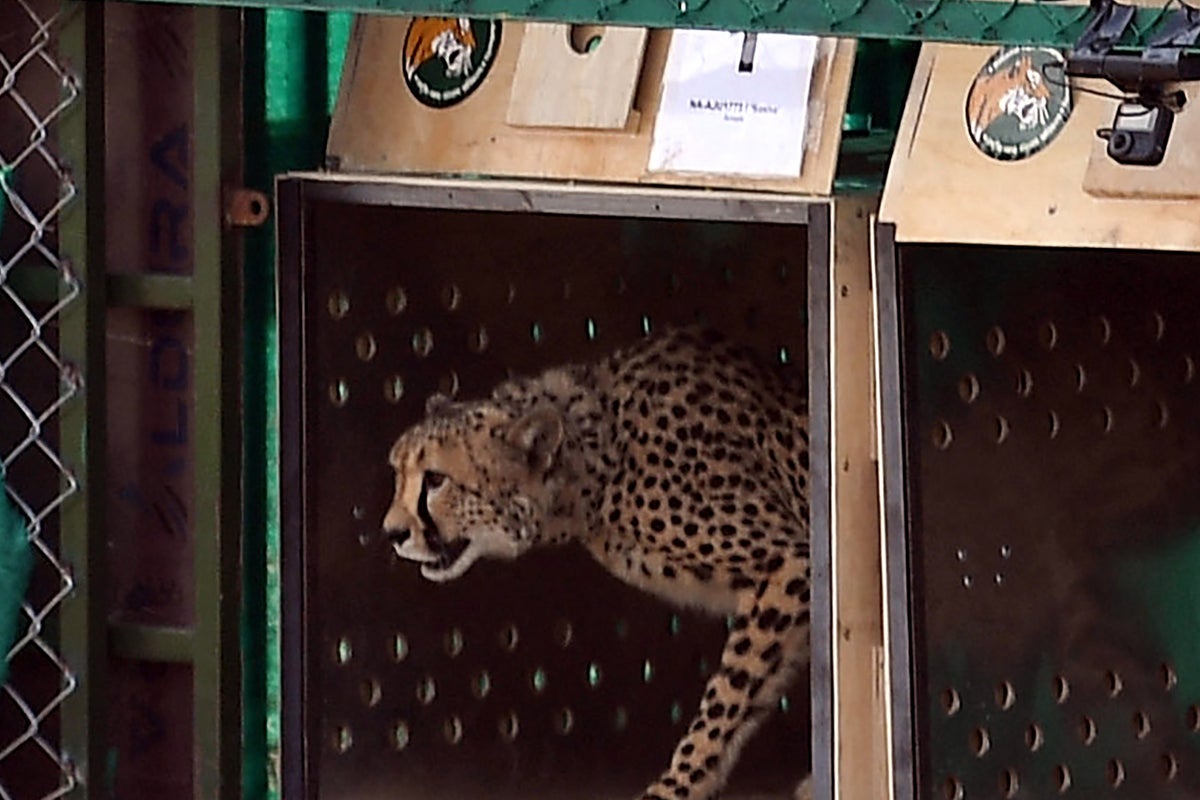
A cheetah cub from the Kuno National Park in central India was struck and killed by a speeding vehicle on Sunday, marking the first recorded roadkill of the big cat since its reintroduction into the country.
The accident occurred near Gwalior in Madhya Pradesh state at around 6.30am local time when two male cubs who had wandered outside the protected forest nearly one month ago tried to cross National Highway 46.
The cubs, 20 months old, were under surveillance by Kuno’s tracking team and local forest staff as they moved through the Ghatigaon region but the collision took place quickly, authorities said.
“The accident happened suddenly even as the tracking team attempted to stop the speeding vehicle from hitting the cheetah,” Project Cheetah director Uttam Kumar Sharma said in a statement.
Forest officials launched an investigation and registered a case.
CCTV footage from multiple points on the highway helped identify the vehicle, which was later intercepted in the neighbouring state of Rajasthan.
Madhya Pradesh’s additional principal chief conservator of forests, L Krishnamoorthy, said a team from Kuno had been dispatched to question the driver and collect forensic samples from the vehicle.
The cub that died was one of the offspring of Gamini, a South African female cheetah released into the wild in March.
The surviving sibling was “healthy” and “doing fine”, park officials said.
The accident came just two days after another cub – released with its mother and a sibling – was found dead in the Parond range, apparently after becoming separated overnight and suffering a fatal fall, according to the Indian Express.
Gwalior police chief Arvind Saxena told the PTI news agency they had “reduced traffic and curtailed speed on the highway to prevent any untoward incident as another male cub separated from the same mother might still be around”.
Thousands of animal fatalities are reported each year along India’s national highways that cut through forested landscapes, including Kaziranga in Assam and the Western Ghats.
Conservationists say the Agra-Mumbai corridor, a key freight route slicing through habitat fragments where the latest accident occurred, is particularly hazardous for wide-ranging carnivores.
Before this week’s deaths, the Kuno National Park housed 30 cheetahs, including 19 India-born cubs and eight adults, with three additional adults recently shifted to the Gandhi Sagar Wildlife Sanctuary.
Since the launch of Project Cheetah in 2022, a total of 21 cheetahs – both translocated adults and India-born cubs – have died from a range of causes such as infection, mating injuries, heat stress, and disease.
India declared the cheetah extinct in 1952, four years after one was seen in the wild.
India and Botswana plan to translocate eight more cheetahs, currently in quarantine in the African nation, as part of the next phase of the programme.
As authorities prepare a detailed report for the National Tiger Conservation Authority, concerns are mounting about the need for structural mitigation on highways bordering wildlife areas.
Forest officials say speed controls, early-warning systems and safe crossing structures may now need urgent prioritisation.
Wildlife activist Ajay Dubey told The Times of India that accountability should be fixed at the highest level on this matter.

