


Have you ever wondered if nonfiction can be truly creative? Many assume creativity belongs only to fiction, while nonfiction must stay factual and plain. In reality, creative nonfiction blends both worlds, turning real-life events into engaging, powerful stories.
The way writers of this genre bring creativity to their nonfiction work is by focusing on meaningful moments that shape the narrative and convey emotion. They use techniques from fiction, such as plot, dialogue, and reflection, that transform facts into vivid stories.
So if you’re still wondering what creative nonfiction is exactly, keep reading as we explore its forms, key elements, and some famous examples.

What Is Creative Nonfiction?
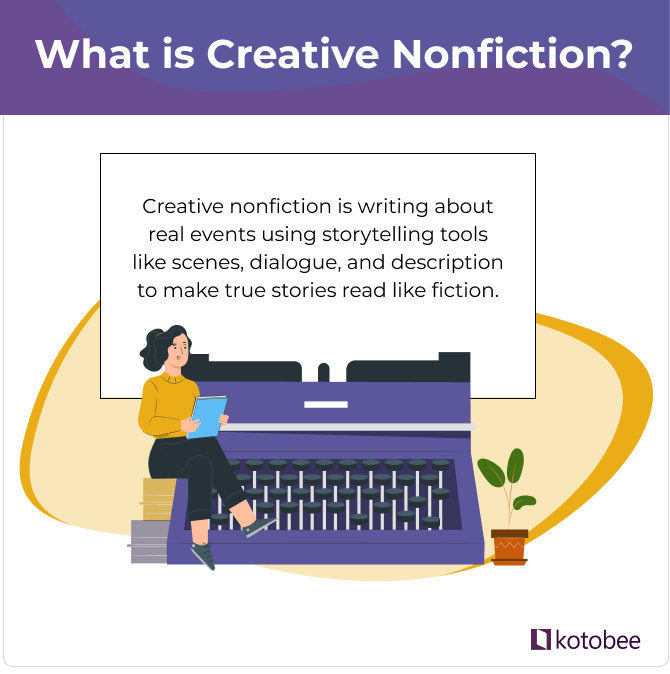
Simply put, creative nonfiction is writing about real-life events in a creative way, much like novels. The key idea behind creative nonfiction is the use of dramatic and literary techniques (such as plot, character, dialogue, and imagery) to describe real experiences and true stories.
With that said, it’s important to note that the word “creative” in creative nonfiction does not give writers permission to imagine or invent events. Instead, it allows them to present the truth in a compelling and thoughtful way. In other words, creative nonfiction sits between facts and storytelling. It stays true to real life while using creativity to make the story meaningful, memorable, and enjoyable to read.
Different Forms of Creative Non-Fiction
Creative nonfiction takes many forms, each offering a distinct way to shape real experiences into stories that inform, interpret, and resonate with readers. Below are some of the most common forms.
1. Personal Essays
When you hear the word essay, you might think of school assignments and a rigid structure. However, a personal essay is very different. This form of creative nonfiction focuses on real experiences from the writer’s own life.
These essays are often personal and honest, allowing the writer to share their thoughts, memories, and emotions in a meaningful way. They use storytelling and literary techniques to reflect on the past and explain why a certain experience matters to them. Rather than simply listing events, it explores feelings, lessons, and personal growth, helping readers connect to the story on a deeper level.
One well-known example of a personal essay is Notes of a Native Son by James Baldwin. In this collection of essays, Baldwin uses first-person narration, carefully constructed scenes, and reflective analysis to explore his personal experiences with race and identity. These techniques allow him to move beyond simple recollection and engage with broader cultural and political questions.
2. Memoirs
Memoirs are similar to personal essays, but they focus more on storytelling rather than reflection alone. It is usually told as a story with a clear beginning, middle, and end. When writing a memoir, the author looks back on past experiences and often reflects on what they learned from them or how those moments changed their life.
This nonfiction work tells a true story from the author’s own life. But instead of covering an entire lifetime, the memoir highlights a specific period, experience, or turning point that had a strong impact on the writer. Through this focused lens, personal experiences are shaped into stories that readers can relate to, learn from, or feel inspired by.
One good example of a memoir is A Tourist at Home by Herb Harris, in which he reflects on returning to his parents’ home during medical school and recalls childhood memories, exploring how familiar places can feel different over time. In this memoir, Harris uses personal narrative along with detailed recollections and reflection to tell a true story from his own life. This makes the memoir feel real and emotionally meaningful.
Important Read: What Is a Memoir and How to Write an Outstanding One?
3. Literary Journalism
Just like other forms of creative nonfiction, literary journalism focuses on real-life events and is supported by in-depth interviews and research. Unlike traditional news reporting, however, it tells true stories using the same narrative techniques and style of fiction writing, making it both informative and engaging.
It’s often referred to as immersion journalism, as it requires the writer to build a close connection with the people involved and spend extended time observing their environment. And just like traditional journalism, literary journalism usually requires accuracy and a strong factual base. However, it goes beyond the headlines to explore the deeper emotional, human side of the story.
One of the famous examples of literary journalism is In Cold Blood by Truman Capote. It is a true story that talks about the murder of a Kansas family that happened in 1959. The story explores the crime, the investigation, and the complex humanity of the killers behind it.
One of the main techniques Capote uses in In Cold Blood is scene-based narration. He presents real events as fully developed scenes, with detailed settings, actions, and dialogue, allowing the true story to read more like a novel.
4. Lyric Essays
The lyric essay is a subgenre of the personal essay that blends prose and poetry. In this form, writers often use poetic language, such as sound repetition and rhythmic phrasing, to express their ideas.
In a lyric essay, the writer does not tell the story in a straight line. Instead, they build the piece using small, meaningful moments or details that readers can easily imagine. These details create mental images about a person, a place, or an object that holds emotional meaning for the writer. By moving between images, the writer helps readers feel the experience rather than just read about it.
A lyric essay is the perfect space to break language rules and allow words to flow freely. Here, writers can express themselves naturally, whether their thoughts appear in complete sentences or fragmented ones.
To see how this form works in practice, take a look at Don’t Let Me Be Lonely by Claudia Rankine. It is an excellent example of a lyric essay, in which she uses moments, thoughts, and reflections to explore personal and social experiences.
The techniques Rankine uses the most in Don’t Let Me Be Lonely are close observation and personal insight. Throughout her writing, she shares her own thoughts, feelings, and experiences about loneliness, grief, and fear. This reflection gives the work emotional depth and allows readers to connect closely with her perspective.
5. Travel Writing
Travel writing is a form of creative nonfiction that focuses on a writer’s journey to a new place or country. Through clear description and personal reflection, it allows readers to see the destination through the writer’s eyes. Good travel writing helps readers imagine the writer’s adventure.
By sharing personal experiences, thoughts, and emotions, travel writing turns a trip into a meaningful story rather than a simple guide. In other words, travel writing is more about connecting the reader to a place they have never been to before.
A famous example of travel writing is Elizabeth Gilbert’s Eat, Pray, Love. In describing her travels to Italy, India, and Indonesia after her divorce, she shares her journey as she searches for peace and meaning while rebuilding and starting fresh. One of the creative nonfiction techniques Elizabeth Gilbert uses in Eat, Pray, Love is observation and vivid description, as she closely notices and describes the details of the people, places, and cultures she encounters during her travels.
Elements of Creative Nonfiction
Now that you understand what creative nonfiction is and the main forms it takes, the next step is learning how to write it. Creative nonfiction becomes easier when you focus on a few key elements that guide the writing process and turn the true story into a compelling piece.
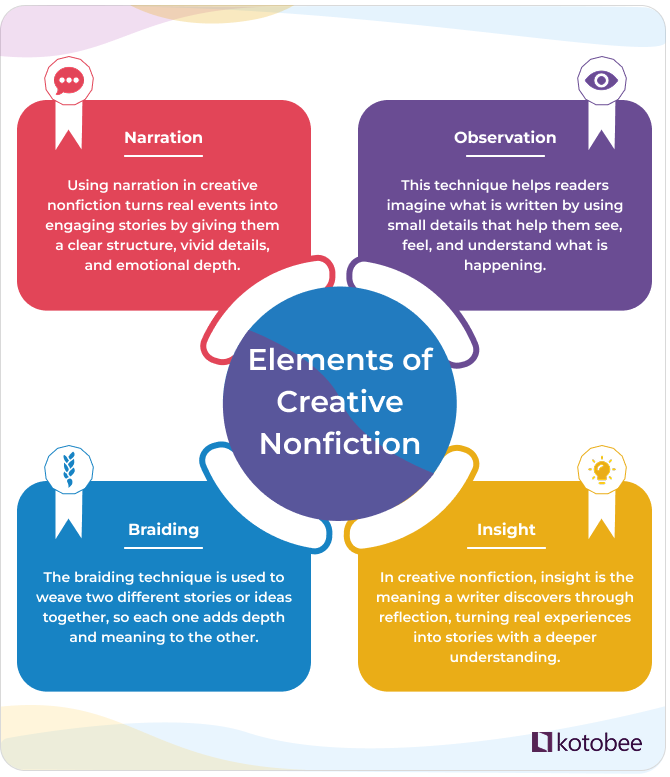
1. Narration
Just like fiction, creative nonfiction depends mainly on captivating narration. Even though you are writing about real events, the way you narrate these events matters just as much as the events themselves. A well-structured narrative helps bring meaning to real-life experiences and keeps readers engaged from beginning to end.
Effective narration involves building a clear flow, shaping events into a compelling storyline, and highlighting the main idea or message behind your experience. The choices you make, such as where to begin your story, what details to focus on, and how to move from one moment to the next, can strongly influence how readers connect with your story.
Narration helps turn real events into explicit scenes with settings, conversations, and details so the story feels alive. Good narration also gives stories structure, such as a clear beginning, rising tension, and meaningful moments, while the writer’s voice adds emotion and depth to the story told.
2. Observation
Observation in creative nonfiction means closely noticing and capturing small, real-life details such as actions, body language, facial expressions, vocal tone, and surroundings. These details help readers clearly see and feel what is happening in the scene.
By observing closely, the writer can set the scene more clearly and help the reader sense what is happening rather than just understand it. The way a person pauses before speaking, avoids eye contact, or shifts their posture can reveal emotions that words alone may not capture. Including these observed details makes the narrative richer and more engaging.
3. Braiding
In simple terms, braiding in creative nonfiction means weaving two different stories or ideas together to create one meaningful piece of writing. Much like strands in a braid, this technique is used to create a richer, cohesive whole that reveals deeper connections and meaning as the threads converge. Instead of focusing on one story from beginning to end, the writer moves back and forth between two threads, allowing them to enrich and deepen each other.
An example can explain this more clearly. In “What We Hunger For,” Roxane Gay uses this technique effectively. The first thread discusses The Hunger Games and its portrayal of female strength. In the second thread, she reflects on her own childhood memories and personal experiences. As the essay unfolds, she breaks both threads into smaller moments and weaves them together throughout the piece.
By connecting these two stories, the writing gains more depth and meaning. Each thread becomes stronger because of the other, and together they create an impact that is greater than either story could achieve on its own.
4. Insight
In creative nonfiction, insight refers to the understanding a writer gains about real experiences through reflection and exploration. This understanding is revealed through his reflection and interpretation rather than simply retelling events. Insight is what gives a real story deeper meaning.
As writers revisit lived experiences, they often pause to question their assumptions, reconsider their reactions, or notice patterns they missed at the time. This process of reflection allows meaning to develop gradually, turning facts and memories into a thoughtful understanding that resonates with readers.
As the story unfolds, writers may discover ideas or understandings they had not noticed before. These moments of realization allow the writer to connect experiences, emotions, and outcomes in a meaningful way.
In a travel memoir, for instance, a writer might recount getting lost in a foreign city (the event) and then realize how the experience taught them patience and the value of trusting strangers (the insight). This reflection adds depth and meaning to the story.
The 5 R’s of Creative Nonfiction
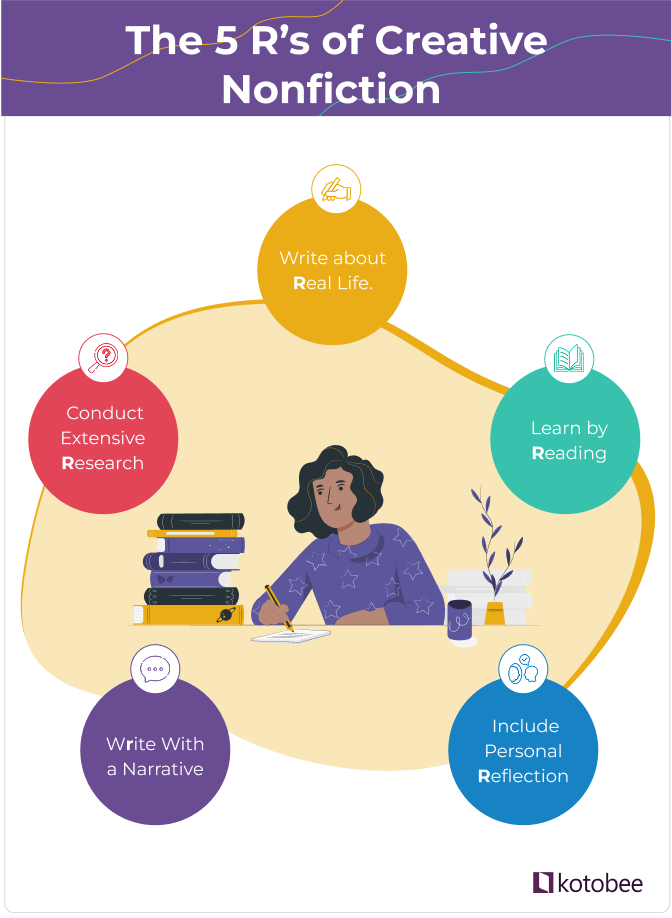
While fiction writers mainly rely on imagination, nonfiction writers carry a different kind of responsibility. They must research carefully and make sure every detail of the story is accurate. Writing about real people and real events means being honest, respectful, and precise. To help with this responsibility, many writers follow a simple checklist known as the 5 R’s of Creative Nonfiction. These principles can guide you through the writing process and help ensure your work stays true and trustworthy.
1. Write about Real Life
Creative nonfiction is always rooted in real people and real events, which makes accuracy essential. Writers have a responsibility to carefully check facts, dates, and details to make sure the story remains truthful.
When possible, visiting the places connected to the story and meeting the people involved can add depth and richness to the writing. Physically being in these locations allows you to observe small details and emotions, and helps you create a more believable narrative for the readers.
2. Conduct Extensive Research
Strong nonfiction writing depends on solid research. Conducting in-depth research ensures the story is accurate, complete, and credible. The more you understand the subject you write about, the stronger your story will be.
So do your best to gather information from reliable and trustworthy sources to avoid errors or misinformation. You can begin your research by using libraries, newspaper archives, books, magazines, interviews, public records, photographs, online resources, and even by spending time in the places connected to the story.
3. Write With a Narrative
Even though the events are real, your story should still read like a story. You can structure your writing with familiar storytelling elements such as an inciting incident, rising conflict, a turning point, a resolution, and a clear ending. This approach makes factual stories more compelling and enjoyable to read.
4. Include Personal Reflection
What sets creative nonfiction apart from journalism is the writer’s voice. Your reflections, thoughts, and interpretations guide the reader through the story. By sharing insights and emotions, you help readers understand not just what happened, but why it matters and what it means to you. You guide the reader through the events of the story.
5. Learn by Reading
Reading is an essential part of becoming a better writer. There is no such thing as reading too much. Creative nonfiction writers, in particular, benefit from reading widely and often. Exposure to different voices, styles, and approaches helps writers understand how real experiences can be shaped into compelling narratives.
By reading books, articles, biographies, and other nonfiction, writers learn how others handle structure, voice, research, and reflection. Over time, this practice sharpens critical thinking, expands perspective, and helps writers develop a stronger sense of their own style.

Final Thoughts
If you have a true story to tell, one that could inspire, comfort, or help others, creative nonfiction could be the perfect place for it, as it gives you the freedom to share actual experiences in a meaningful and engaging way. It also proves that real stories can move readers just like fiction does!
So if you’ve been waiting for the right moment to begin, this is it! Pick up a pen, open a blank page, and start telling your story.
More from Our Blog
A book festival is where literature turns into a celebration;…
Every craft needs a space where people can meet, share…
Writing residencies open a door to uninterrupted time with your…

