


When the U.S. Department of Homeland Security (DHS) posted a single word—remigrate—on X in October 2025, it wasn’t a vague message. A once neutral term dating back to the 17th century, meaning “to migrate back” or “to return,” remigration has evolved into a euphemism for forced deportation under the guise of policy. A government agency invoking it naturally sparked debate about this historically fraught concept.
Remigrate.
— Homeland Security (@DHSgov) October 14, 2025
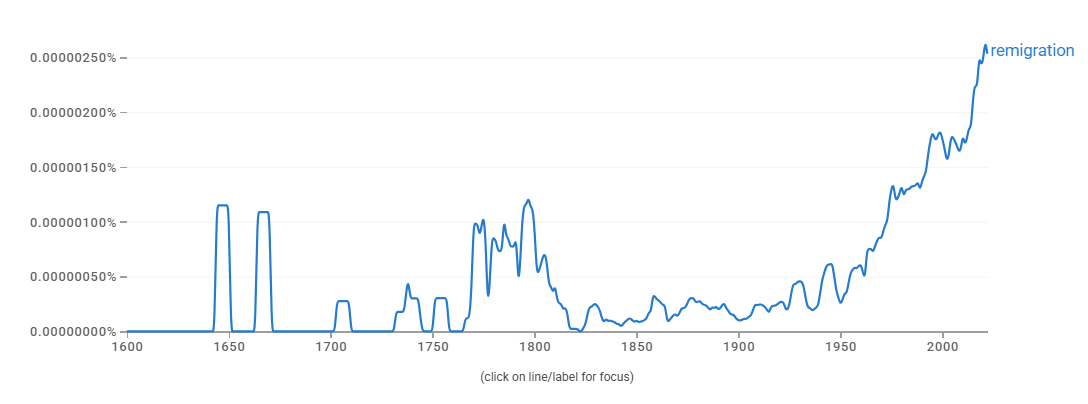
Google Books Ngram, an online tool that tracks the historical frequency of word usage in print, shows remigration peaking in 1797 amid a surge of nativist sentiment that would soon produce the Alien and Sedition Acts of 1798—a series of restrictive laws that increased residency requirements and empowered the federal government to deport “dangerous aliens.”
The next peak occurred nearly 150 years later, in 1945. This marked the resettlement of the Jewish diaspora following World War II as hundreds of thousands of Jewish expatriates, facing rampant antisemitism, struggled to return to their war-torn homes.
Harking back to this dark historical epoch, modern usage of remigration—which, according to Google Ngram, has increased threefold over the past 50 years—carries increasingly xenophobic connotations. Right-wing groups, predominantly in Europe, have co-opted the word as a dog whistle. “In Europe, it’s an established part of the linguistic toolbox of white supremacy,” Nicholas J. Cull, a professor of communication at the University of Southern California, told Time magazine.
While campaigning for the European Parliament, Renaud Camus—the chief architect of the white nationalist conspiracy theory known as the “Great Replacement”—promoted remigration as a part of his campaign platform, using it as a euphemism for the mass expulsion of immigrants. “We shall not leave Europe,” his campaign slogan opined. “We shall make Africa leave Europe.”
Remigration has also become especially prominent in German politics—so much so that, in 2023, German linguists distinguished it as Unwort des Jahres (“Bad Word of the Year”).
Germany’s far right touts remigration in its radical vision to reshape the country. Speaking to party delegates, Alice Weidel, leader of the Alternative for Germany (AfD), the country’s leading populist political party, spoke of “large-scale repatriations.”
“If it’s going to be called ‘remigration,’ then that’s what it’s going to be: remigration,” Weidel said.
Remigration softens the troubling image of rounding up and expelling countless people from a country, as is the goal of any euphemism. “In five to 10 years, everyone in Europe will be calling for remigration,” said Martin Sellner, a prominent Austrian white nationalist.
Sellner may be right. The AfD currently polls higher than it ever has, and two out of three Germans believe the country should “take in fewer refugees.”
Support for remigration has spread beyond Europe’s far right, as evidenced by the DHS’ social media. This one word speaks volumes about the current anti-immigrant zeitgeist sweeping through liberal democracies worldwide.
This article originally appeared in print under the headline “DHS Brings an Ugly Past Back to the Surface.”

