


Indian investigators are nearing the conclusion of their probe into the fatal Air India crash in June 2025, which claimed 260 lives.
A new court filing has revealed that a cockpit voice recorder transcript has been prepared and a psychological autopsy conducted as part of the extensive inquiry.
The filing, however, did not specify whose psychological assessment was carried out, nor did it disclose any findings concerning the Boeing 787 disaster that occurred shortly after its take-off from Ahmedabad, India.
An analysis of data retrieved in late May from an engine monitoring unit remains awaited, and an assessment of certain organisational factors is still in progress, India’s Aircraft Accident Investigation Bureau (AAIB) added.
The AAIB said that investigators have conducted extensive interviews, speaking with Air India 787 pilots, crew members who had previously flown with the pilots of the crashed aircraft, technical personnel involved in preparing the jet, air traffic controllers, weather officials, and human-factors specialists.
The families of the flight crew were also approached at their residences during the early stages of the investigation, the AAIB said in the filing, which was dated Tuesday.
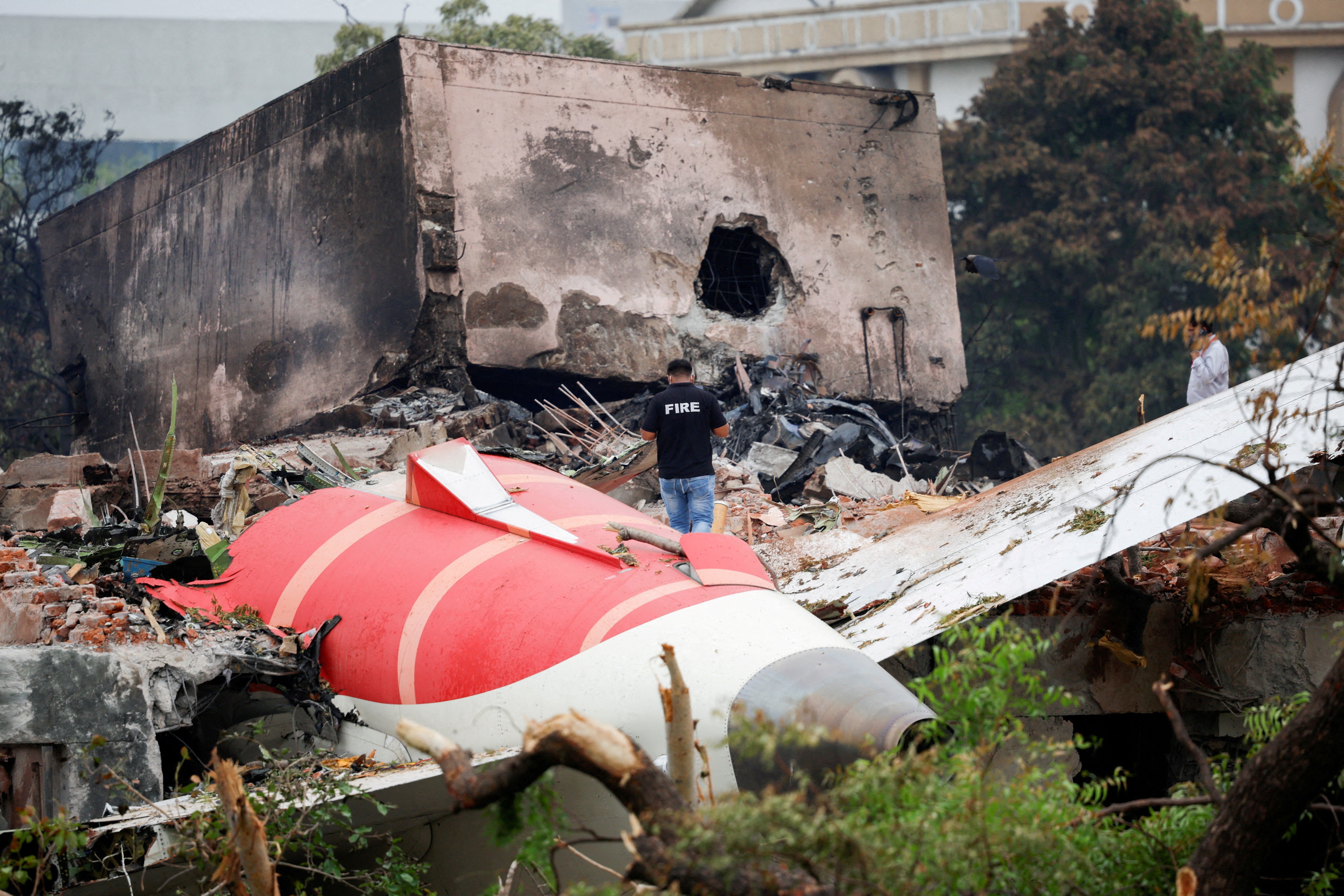
Here is the sequence of events from 12 June 2025, by the second, as revealed in the cockpit voice recorder transcript.
The quotes within the transcript are as detailed by Indian investigators in their preliminary report released on 12 July 2025.
05:47 GMT (11:17 a.m. IST) – Air India Dreamliner VT-ANB landed in Ahmedabad from New Delhi as AI423.
07:48:38 GMT – The aircraft was observed departing from Bay 34 at the airport.
07:55:15 GMT – The aircraft requested taxi clearance, which was granted by air traffic control; a minute later the aircraft taxied from the bay to Runway 23 via Taxiway R4, backtracked and lined up for take-off.
08:02:03 GMT – The aircraft was transferred from ground to tower control.

08:07:33 GMT – Take-off clearance issued.
08:07:37 GMT – The aircraft started rolling.
08:08:39 GMT – Aircraft lifted off. “The aircraft air/ground sensors transitioned to air mode, consistent with liftoff,” the report said.
08:08:42 GMT – Aircraft reached max airspeed of 180 knots. “Immediately thereafter, the Engine 1 and Engine 2 fuel cutoff switches transitioned from RUN to CUTOFF position one after another with a time gap of 01 sec.”
“The Engine N1 and N2 began to decrease from their take-off values as the fuel supply to the engines was cut off.
“In the cockpit voice recording, one of the pilots is heard asking the other why did he cutoff.
“The other pilot responded that he did not do so.
“The CCTV footage obtained from the airport showed Ram Air Turbine (RAT) getting deployed during the initial climb immediately after lift-off.
“The aircraft started to lose altitude before crossing the airport perimeter wall.”

08:08:47 GMT – Both engines’ values “passed below minimum idle speed”, and the RAT hydraulic pump began supplying hydraulic power.
08:08:52 GMT – Engine 1 fuel cutoff switch transitioned from CUTOFF to RUN.
08:08:56 GMT – Engine 2 fuel cutoff switch also transitioned from CUTOFF to RUN.
“When fuel control switches are moved from CUTOFF to RUN while the aircraft is inflight, each engines full authority dual engine control (FADEC) automatically manages a relight and thrust recovery sequence of ignition and fuel introduction.”
“Engine 1’s core deceleration stopped, reversed and started to progress to recovery. Engine 2 was able to relight but could not arrest core speed deceleration and re-introduced fuel repeatedly to increase core speed acceleration and recovery.”
08:09:05 GMT – One of the pilots transmitted “MAYDAY MAYDAY MAYDAY”.
08:09:11 GMT – Data recording stopped.
08:14:44 GMT – Crash fire tender left the airport premises for rescue and firefighting.
Who were the pilots of the doomed Air India flight?

CAPTAIN SUMEET SABHARWAL
The 56-year-old had an airline transport pilot’s licence that was valid until 14 May 2026.
He had obtained clearances to fly as pilot-in-command on several aircraft including the Boeing 787 and 777 and the Airbus A310.
He had total flying experience of 15,638 hours, with 8,596 of those hours on a Boeing 787.
Mr Sabharwal had called his family from the airport, assuring them he would ring again after landing in London, according to a Times of India report. A pilot who had briefly interacted with him told Reuters he was a “gentleman”.
Mr Sabharwal’s father asked India’s Supreme Court to order an independent investigation, taking into account causes other than pilot action.
He said two officials from India’s Aircraft Accident Investigation Bureau (AAIB) who visited him after the crash had implied that his son cut the fuel to the plane’s engines after takeoff.
FIRST OFFICER CLIVE KUNDER
The 32-year-old had a commercial pilot licence that was issued in 2020 and valid until 26 September 2025.
He had obtained clearances to fly Cessna 172 and Piper PA-34 Seneca aircraft as pilot-in-command and on Airbus A320 and Boeing 787 jets as a co-pilot.
Mr Kunder had total flying experience of 3,403 hours, with 1,128 hours of that as a 787 co-pilot.
He had been passionate about flying since school, and in 2012, began serving as a pilot, Indian media reported, citing his relatives.
Mr Kunder went to Florida to attend flight school, the Wall Street Journal reported in 2025. He was hired by Air India in 2017 and began flying on the Airbus A320 before the airline switched him to the 787, the newspaper reported.
Mr Kunder’s family and friends described him as a fan of superhero movies who taught himself how to build a PC from scratch and in college nearly pursued a pro-esports career, the report added.
