


“Hate Has No Home Here,” read the classroom poster. The school board said it had to go. Now, the teacher who put up the poster is suing, saying his First Amendment rights were violated.
How could such an anodyne message spark a constitutional controversy? The drama stems from the images under the words: five hands—of varying skin colors—holding five hearts, each decorated differently. The largest heart features an American flag pattern. One heart has a peace sign on it. The controversial hearts feature stripes, one in a rainbow of colors and one in pink, blue, and white.
The Little Miami school board says these images violate the district’s policy regarding instructional materials “relating to sexual orientation or gender identity.”
You are reading Sex & Tech, from Elizabeth Nolan Brown. Get more of Elizabeth’s sex, tech, bodily autonomy, law, and online culture coverage.
The striped hearts are, of course, done up in the colors of LGBTQ and transgender pride symbols—though that’s something one would only know if they’re already aware of these symbols. The images themselves are simply striped hearts, and the poster makes no mention of anything related to sexual orientation or gender identity.
What’s more, the teacher in this case—going in court documents by John Doe—said he never offered classroom instruction based on the poster. So, the idea that it represented classroom instruction related to sexual orientation or gender identity seems somewhat lacking.
Taken at face value, this poster does not say anything about the morality of same-sex attraction. It does not encourage gender nonconformity or weigh in on what really makes someone a girl or a boy. It simply suggests that we should not hate people based on sexual orientation, gender identity, skin color, or other characteristics.
The purpose of the poster was to suggest that “bullying and/or targeting will not be tolerated,” Doe told school board members in an email obtained by The Cincinnati Enquirer. “I have never incorporated the flag into the curriculum itself or used it as an instructional item when covering any sensitive topics in class.”
The “Hate Has No Home Here” poster is one of many posters and flags hung in Doe’s classroom, per his suit. There’s also an American flag, a Cincinnati Bengals flag, a “COEXIST” poster featuring different religious symbols, photographs of presidents and civil rights leaders, a Rosie the Riveter poster, vintage Uncle Sam “I Want You” recruitment posters, a Christmas Story poster, and a Batman poster.
According to Doe’s lawsuit, Little Miami School Board President David Wallace saw the poster hanging in his high school social studies classroom and filed a complaint. In February, the board voted 4–1 to require the poster’s removal, saying it fell into the category of “instruction that includes sexuality content” and would trigger the district’s “Parents’ Bill of Rights.” [Is this the right link?]
Little Miami’s parental rights policy was adopted in direct response to an Ohio law that took effect last summer. That law requires all public school districts to “provide parents the opportunity to review any instructional material that includes sexuality content” and, at a parent’s request, excuse students “from instruction that includes sexuality content and [permit them] to participate in an alternative assignment.”
The new law defines sexuality content as “any oral or written instruction, presentation, image, or description of sexual concepts or gender ideology provided in a classroom setting.” But it explicitly exempts “incidental references to sexual concepts or gender ideology occurring outside of formal instruction or presentations on such topics, including references made during class participation and in schoolwork.”
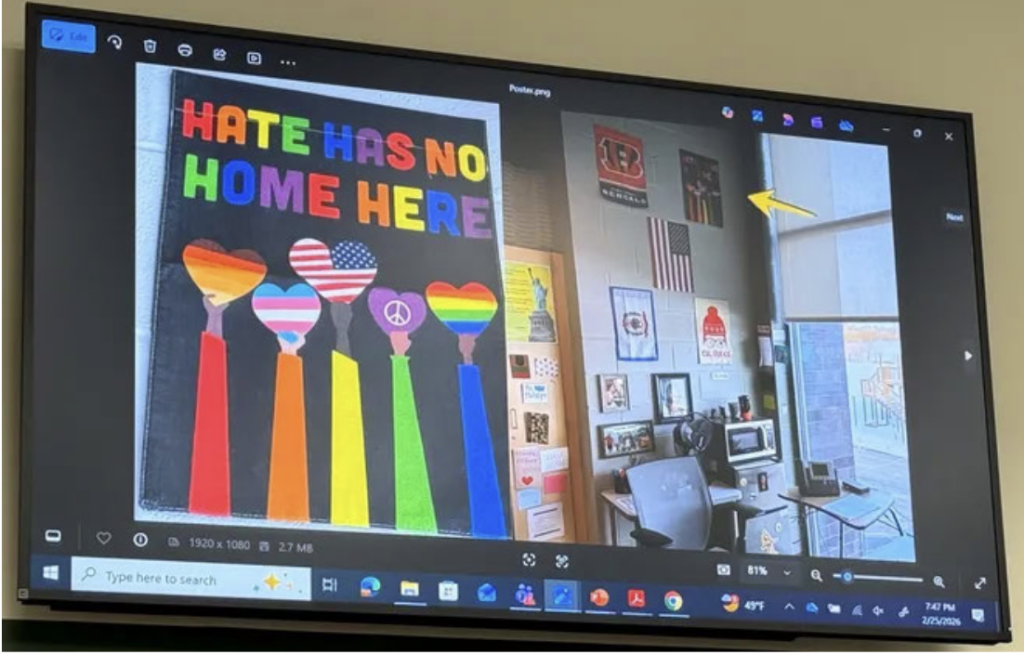
As part of his suit, Doe wants to be able to hang the poster back up. Whether Doe will prevail on his free speech claims or not, the case highlights how out of control school policies against LGBTQ content can get.
In this case, it’s unclear if Doe’s poster would even count as “sexuality content” under Ohio law and trigger a parental notification requirement. And, even if it did, it’s not clear that any parents of students in Doe’s classes would object to the poster passively hanging there. Nonetheless, the Little Miami School Board simply voted to require its removal preemptively.
Parents and politicians who push for policies like these often say that they’re simply against inappropriately sexual themes entering elementary school classrooms. But time and again, we’re seeing school administrators target general and innocuous messages about inclusivity—or books that include gay or transgender characters.
In another Ohio school controversy, teacher Karen Cahall sued over her school district’s response to her having four books with LGBTQ characters in her third-grade classroom.
The books—Ana On The Edge by A.J. Sass, The Fabulous Zed Watson by Basil Sylvester, Hazel Bly and the Deep Blue Sea by Ashley Herring Blake, and Too Bright to See by Kyle Lukoff—did not include any sexual content, Cahall pointed out in a 2024 federal lawsuit. Moreover, they “were intermingled among approximately one hundred other books, were not prominently displayed by plaintiff Karen Cahall in her classroom, plaintiff Karen Cahall did not teach from those books as part of her instructional program, and did not require students to read those books.”
“These books each deal with characters who are LGBTQ+ and are coming to terms with feeling different and excluded simply because they are LGBTQ+ and serve to reinforce plaintiff Karen Cahall’s sincerely held moral and religious beliefs that all children, including children who are LGBTQ+ or the children of parents who are LGBTQ+, deserve to be respected, accepted, and loved for who they are,” states Cahall’s lawsuit.
For having these books in her classroom, Cahall was suspended for three days without pay. She was also ordered to remove not just those four books but her whole classroom library of about 100 books.
Cahall’s suit was dismissed, with the U.S. District Court for the Southern District of Ohio finding that New Richmond’s “controversial issues” policy, under the auspices of which it acted to require the books’ removal, was not unconstitutionally vague.
Now, Cahall—who is still employed as a third-grade teacher at New Richmond’s Monroe Elementary—has “teamed up with experts across the state, including a former student, to launch the Rainbow Classroom Fund, aimed at giving Ohio teachers more legal and educational support than she had,” the Enquirer reports.
She is also appealing the lower court’s ruling dismissing her case.
“The absence of any articulable standard for determining whether simply maintaining a book featuring an LGBTQ+ character implicated the ‘controversial issues’ policy and the lack of any articulable standard for determining whether simply maintaining a book make it part of an ‘instructional program’ when it is not used in classroom instruction exacerbated the violation of Ms. Cahall’s due process rights,” her appeal states.
Facial recognition glasses are ‘dangerous and dystopian.’ The American Civil Liberties Union (ACLU) and 75 other groups are urging Meta to drop reported plans to include facial recognition technology in its artificially intelligent glasses.
“The American people have not consented to this massive invasion of privacy,” Kade Crockford, director of technology and justice programs at the ACLU of Massachusetts, said in a statement. “Stalkers and scammers would have a field day with this technology. Federal agents could use it to harass and intimidate their critics. It’s dangerous and dystopian, and Meta must disavow it.”
In February, The New York Times reported that Meta “plans to add the feature to its smart glasses, which it makes with the owner of Ray-Ban and Oakley, as soon as this year,” and it “would let wearers of smart glasses identify people and get information about them via Meta’s artificial intelligence assistant.”
But the Times also suggests that the idea is tentative and notes that “Meta’s plans could change.”
The ACLU and other civil liberties groups are trying to spur that change. “Facial recognition technology built into inconspicuous consumer eyewear represents a serious
threat to privacy and civil liberties for every member of our society, and particularly for
historically marginalized and vulnerable groups,” says their April 13 letter. More:
People should be able to move through their daily lives without fear that stalkers, scammers, abusers, federal agents, and activists across the political spectrum are silently and invisibly verifying their identities and potentially matching their names to a wealth of readily available data about their habits, hobbies, relationships, health, and behaviors.
Meta’s reported plans to introduce this technology into broadly available consumer products is a red line society must not cross. Preventing this outcome is not just a privacy preference. It is a prerequisite for a free and safe society.
Meta should not proceed with this product release.
The new social media ban in Massachusetts is so sweeping in its definition of “social media” that it would require age-verification for Wikipedia. You don’t protect kids by cutting off resources.acrobat.adobe.com/id/urn:aaid:…
— Mike Stabile (@mikestabile.bsky.social) 2026-04-08T23:19:59.555Z
More on the bill here.
• Recent court rulings are making Section 230 functionally irrelevant, warns Mike Masnick of Techdirt.
• Emily Oster pushes back on the theory that smartphones are behind global test score declines.
Did smart phones cause global test score declines? No, probably not. (It was school closures).
A cautionary note about accepting results because they confirm our priors…https://t.co/ktYd7whWdN
— Emily Oster (@ProfEmilyOster) April 13, 2026
• “Facebook and Instagram parent company Meta changed its speech rules to add new restrictions around posts including the word ‘antifa,'” reports The Intercept.
• Off Christopher Street, a new podcast from David Sessions and Blake Smith, uses the archives of the mid–20th century magazine known as the “gay New Yorker” as a jumping-off point to talk about today’s gay culture.
• The government is using a grand jury to try and unmask an anonymous Reddit user, and the “whole thing looks like a fishing expedition by the DOJ on behalf of ICE,” notes Tim Cushing.
• A new bill in France seeks to decriminalize sex work for both buyers and sellers.
• Freya India argues that social media has had a feminizing effect on everyone who interacts with it—or, more specifically, that it’s made grown women and men alike act like teen girls. Katherine Dee’s pushback is worth a read.
• Anthropic and OpenAI continue to demonstrate their differences in values:
New: Anthropic is opposing the OpenAI-backed Illinois bill that would shield AI labs from liability for mass deaths or financial disasters caused by AI models.
Governor Pritzker is signaling he doesn’t like the bill, but it’s exposing new battlelines in the AI policy debate. pic.twitter.com/fQnYbmdCQ8
— Max Zeff (@ZeffMax) April 14, 2026
• A plea to keep Siri dumb

