

Missed the gym again, the weather is miserable, and your motivation is hanging by a thread? That is exactly when a home workout without equipment stops being a backup plan and starts looking like the smartest option you have. You do not need a rack of weights, a folding bench or a spare room to get fitter. You need a small bit of floor space, a plan that makes sense, and enough realism to work with your actual schedule rather than the fantasy version of it.
The biggest reason people give up on training at home is not lack of gear. It is lack of structure. Random squats and a few rushed press-ups can leave you sweaty, but that is not the same as training with purpose. If you want results, your sessions still need balance. That means hitting your legs, upper body, core and cardio in a way that feels challenging but sustainable.
Why a home workout without equipment can still be effective
Bodyweight training gets underestimated because it looks simple. In practice, simple is often what people stick to. A programme that fits into a lunch break or the gap before dinner has a better chance of becoming routine than a complicated schedule that depends on travel, kit and perfect timing.
There is also more room for progression than many people expect. You can slow a movement down, add pauses, increase reps, reduce rest, switch to single-leg or single-arm versions, or combine moves into circuits. That is enough to keep most beginners and plenty of intermediate exercisers challenged for quite a while.
The trade-off is worth knowing. If your only goal is maximum muscle growth or very specific strength numbers, bodyweight-only training can become limiting over time. But for general fitness, fat loss support, better mobility, improved stamina and stronger day-to-day movement, it is more than enough.
What a good no-kit session should include
A useful home session does not need to be long, but it should cover a few basics. You want a lower-body move like squats or lunges, an upper-body push like press-ups, some core work, and something to raise your heart rate. That mix gives you more value than hammering one area and calling it done.
You also want the intensity to match your level. If you are brand new, five quality press-ups against a kitchen counter can be better than twenty messy ones on the floor. If you are fitter already, you may need harder variations, tighter rest periods or longer rounds to get the same training effect.
The best moves for a home workout without equipment
Squats are the obvious starting point, and for good reason. They train your legs and glutes, they are easy to scale, and they help build movement confidence. If standard bodyweight squats become too easy, pause at the bottom for two seconds or switch to split squats.
Lunges add a balance challenge that makes your legs work harder without adding any kit. Reverse lunges tend to be more knee-friendly for many people, while walking lunges need a bit more space. If balance is an issue, hold onto a wall lightly and focus on control.
Press-ups are still one of the best upper-body bodyweight exercises going. They work your chest, shoulders, arms and core in one move. If floor press-ups are too difficult, elevate your hands on a sofa or sturdy table. If they are too easy, slow the lowering phase or try decline press-ups with your feet raised.
Glute bridges do not look dramatic, but they are useful, especially if you sit for most of the day. They target the back of the hips and can help balance out all the front-dominant work people often do. Marching glute bridges or single-leg versions raise the difficulty quickly.
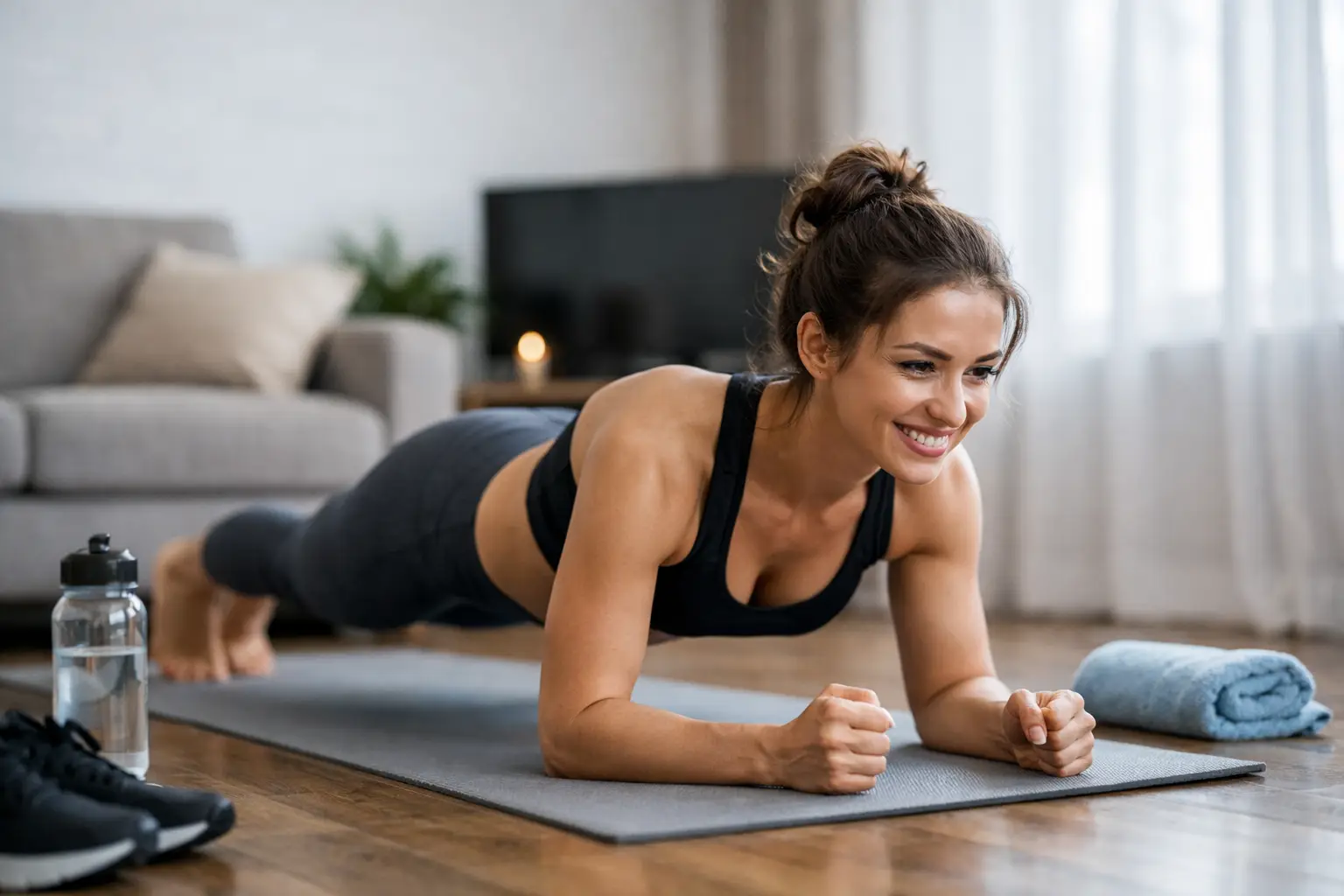
For core work, planks are popular because they are simple to set up and hard to fake. That said, not everyone needs to hold a plank for ages. Dead bugs, mountain climbers and slow bicycle crunches can be just as effective depending on your goal. The key is keeping tension and moving with control rather than rushing through reps.
Burpees, high knees and squat thrusts are your cardio heavy hitters when space is limited. They lift the heart rate fast and turn a strength-focused routine into more of a conditioning session. The downside is impact. If you live in a flat or have sensitive joints, lower-impact swaps like fast marching, step-backs and controlled climbers may be the smarter choice.
A practical 20-minute routine to start with
If you want a straightforward plan, try this circuit three times through. Work for 40 seconds, rest for 20 seconds, then move on. Start with squats, then press-ups, reverse lunges, glute bridges, mountain climbers and a plank. Rest for one minute at the end of the round.
This format works because it is easy to follow and easy to adapt. Need it easier? Work for 30 seconds and rest for 30. Need it harder? Add a fourth round, cut your rest, or use tougher exercise variations. If you can chat comfortably all the way through, you probably need to increase the challenge a little.
For absolute beginners, there is no shame in doing half the time or taking extra breaks. The best version of this session is the one you can repeat next week, not the one that leaves you unable to sit down properly for three days.
How often should you train?
For most people, three or four sessions a week is a solid target. That is enough to build momentum without making your life revolve around workouts. If your weekdays are chaotic, even two proper sessions can move things forward if you stay consistent.
The rest of your movement still matters. A short walk, a few mobility breaks between meetings, or taking the stairs all add up. A home workout without equipment works best when it sits inside a generally active week, not as the only movement you do.
Common mistakes that slow progress
The first mistake is doing the same routine at the same pace for months. Your body adapts quickly. If nothing changes, your results usually stall too. Progression does not need to be dramatic, but it does need to exist.
The second mistake is chasing exhaustion instead of quality. A workout that leaves you flat on the carpet is not automatically better than one with controlled reps and smart structure. Good form matters, especially when you are training alone and relying on feel rather than a coach.
Then there is the all-or-nothing trap. Missed Monday? Fine. Training at home should reduce excuses, not create new ones. Ten focused minutes still count, and they usually keep the habit alive better than waiting for the mythical perfect hour.
How to make home training less boring
Let us be honest, this is where many routines fail. The novelty fades. Your living room is still your living room, and repeating the same circuit can start to feel like punishment. The fix is not always buying gear. Often it is changing the format.
One week, use timed intervals. The next, count reps. Another time, try an EMOM style session where you complete a set amount of work every minute on the minute. You can also theme sessions around legs, core and cardio, or upper body and conditioning. Small changes keep your brain engaged.
Music helps. So does setting a very clear target before you begin, whether that is four rounds, twenty minutes, or beating last week by a handful of reps. Vague workouts are easier to skip.
Who benefits most from this approach?
People with packed schedules often get the biggest return. If commuting to a gym eats an hour you do not have, home training removes the main barrier straight away. It also suits beginners who feel intimidated by gym floors, parents trying to squeeze movement into unpredictable days, and anyone rebuilding fitness after time off.
That said, it is not a magic fix for everyone. Some people genuinely train better around others. Some need the accountability of classes or the satisfaction of lifting heavier and heavier loads. If home workouts bore you senseless, forcing them forever is probably not the answer. The best plan is still the one you will follow.
The good news is that fitness does not have to look impressive to be effective. A clear routine, a bit of floor space and twenty consistent minutes can do more for your energy and strength than another week of putting it off. Start where you are, keep it simple, and let the habit do the heavy lifting.

