


There is a massive difference between a poem that sits quietly in a dusty book and one that demands to be heard. Spoken word is exactly where that magic happens. It throws out rigid, old-school rules and perfect rhyming schemes, and thrives instead on raw honesty, rhythm, and making an audience collectively hold their breath.
Learning how to write spoken word poetry is all about taking the ordinary moments of your life and turning them into a shared sensory experience. And while moving your words from a quiet notebook page to a live microphone can feel intimidating, that vulnerable leap is where your voice truly finds its power.
So if you are ready to find your unique spark and learn how to format your writing to leave a room in awe, this guide will show you exactly how to make it happen.
What Is Spoken Word Poetry?
Spoken word poetry is a performance art that relies on the human voice to bring written words to life. Instead of letting a poem sit quietly on a page, spoken word drags it onto the stage in front of a live audience.
To really connect with the room, poets don’t just read their lines; they perform them. They use their full bodies, intentional hand gestures, and shifting vocal tones to turn a story into an unforgettable emotional experience.
Spoken Word vs Traditional Poetry
While both styles use beautiful language and deep emotion to convey a message, they are built for entirely different environments. The easiest way to think about the difference between the two is to look at the final destination of the words.
Traditional poetry is written primarily for the eye; it is designed to be read silently from a page, allowing the reader to interpret the pacing in their own head. Spoken word poetry, on the other hand, is written primarily for the ear. It relies entirely on a performer’s live voice, physical presence, and theatrical execution to give the text its meaning.
The following table summarizes the difference between the two:
| Feature | Traditional Poetry | Spoken Word Poetry |
| Where it Lives | Printed in books, literary journals, or on a screen. | Performed live on a stage or at a slam competition. |
| Structure & Flow | Relies on visual layout, precise line breaks, or rigid historical meters (like sonnets). | Completely free-form and conversational, prioritizing natural speech patterns and rhythm. |
| How Rhyme is Used | Often uses predictable, structured rhyme schemes at the ends of lines (like AABB). | Scatters rhymes unexpectedly or internally within lines to highlight specific images. |
| Audience Experience | An intimate, quiet, and reflective moment between a single reader and the text. | A shared, high-energy event where the audience reacts out loud in real time. |
How to Write Spoken Word Poetry
Turning raw thoughts into a compelling performance piece comes down to a simple creative process. Luckily, you don’t have to guess your way through it. By breaking this process down into actionable steps, you can easily transform your ideas into a spoken word poem that is designed to captivate your audience.
Step 1: Coming Up with Ideas
Before you can write a single line, you need to find your spark or inspiration. And while many beginners often make the mistake of trying to write about massive, abstract concepts like “Time” or “Heartbreak” right out of the gate, spoken word relies on raw honesty in describing everyday situations.
The secret to great spoken word is to start small. Think of a single, physical object or a hyper-specific moment that holds emotional weight for you. Here are some ideas for how to find that spark:
- Look at the world through a writer’s eyes: Try walking through the world with your senses wide open. You want to be in a constant state of taking in ordinary information and rephrasing it poetically. Listen to the rhythm of passing conversations, notice the textures of the things you touch, and ask yourself: How would I describe this to someone who can’t see it?
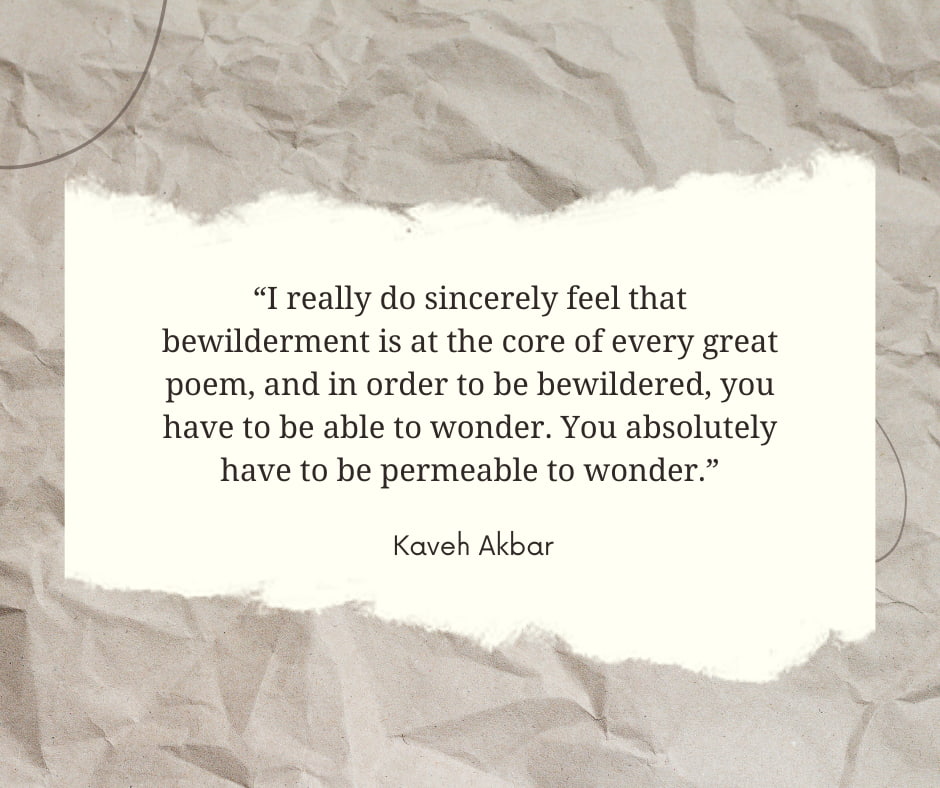
- Borrow from other art forms: If you are struggling to find inspiration in your immediate surroundings, look to the creations of others. Refer to that piece of art that fuels your creative energy. Be it a painting, a book, or a sculpture, art has this power of leaving you speechless; not because you have nothing to say, but because you’re overwhelmed with emotions. So after you take it all in, think about how you would describe those feelings or thoughts to someone else.
- Lean into vulnerability: The most successful poems are the ones people can relate to on a deep level. This happens when you, the poet, are willing to be honest and vulnerable about what you feel. If you are angry, let the words bite. If you are grieving, let them ache. When you feel the emotion intensely on the page, your audience will feel it intensely in the room.
- Use writing prompts: There will be days when the inspiration simply isn’t hitting, and staring at a blank page feels paralyzing. When your creative well runs dry, don’t force it; turn to writing prompts and exercises instead. These prompt exercises can act as a catalyst that unlocks hidden memories or uncovers unexpected ideas you didn’t even know you had within you.
Step 2: Structuring and Crafting Your Poem
The next step after finding your inspiration isn’t to write a perfect final draft on the first try. Instead, your job is to come up with a structural spine for your poem. You need to take those scattered ideas in your head and arrange them into a deliberate narrative arc. And to show you exactly how this works, we are going to build a spoken word piece together throughout this section.
Here’s how you can go about it:
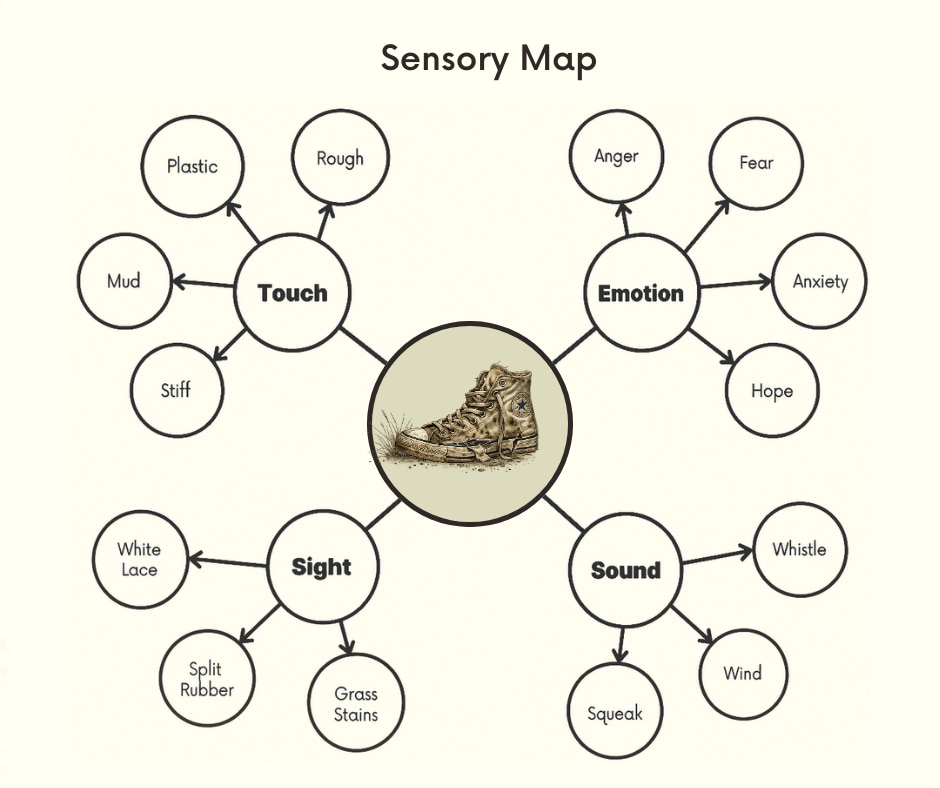
- Build a sensory mind map: Once you have an object, a piece of art, or a moment in mind, put it in the center of a blank page and branch out. Don’t worry about rhyming or writing full sentences yet. Just write down raw emotions, memories, and sensory details.
Applying this to our poem:
Our inspiration for the poem you’ll build together is a pair of old, beat-up sneakers sitting in the back of a closet. If we draw a mind map for these shoes, our raw sensory notes might look like this:
- Sight: Frayed white laces, a split rubber sole, grass stains from three summers ago.
- Touch: The canvas is stiff from dried mud, and the inside heel is worn down to the plastic.
- Sound: The rhythmic squeak-slap on the pavement when sprinting.
- Emotion/Memory: The feeling of running away from home when angry; the literal miles walked to a first job; the fear of standing at a crossroads.
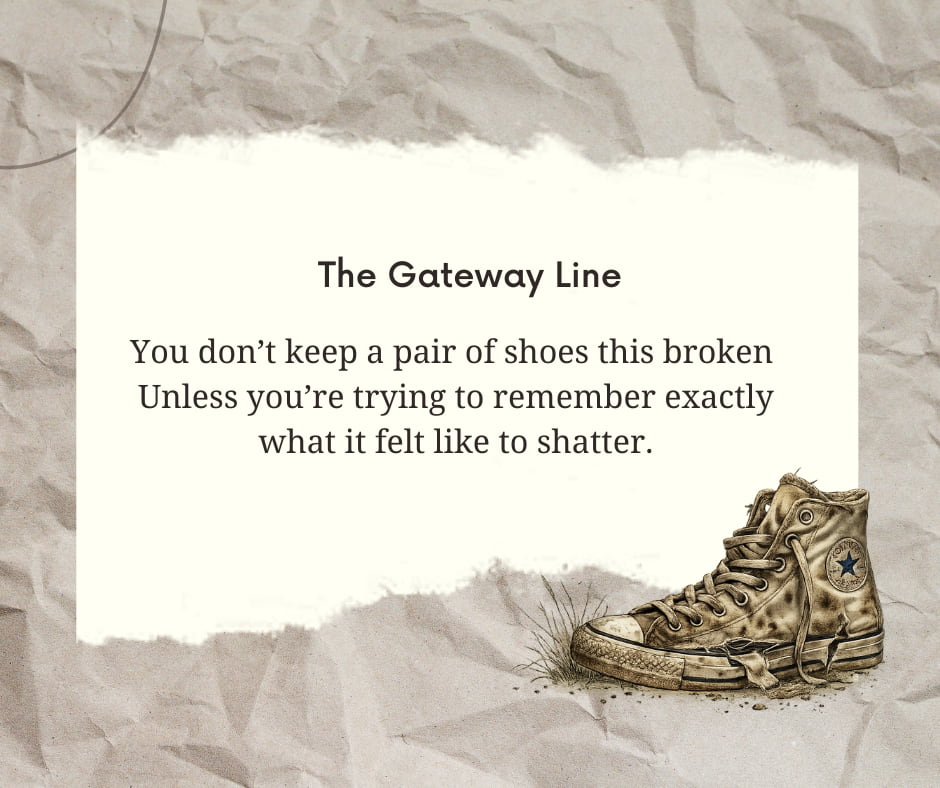
- Come up with your gateway line: The next thing you want to do is to write a gateway line, which is a single, powerful sentence that completely captures the core idea of your poem. Think of this line as your thesis statement; it tells the audience exactly what the deep, emotional truth of your piece is going to be. Everything that follows this line in your drafting process must actively support, expand, or challenge that initial idea.
Applying this to our poem:
Looking at the sensory map, a pattern begins to emerge. The shoes aren’t just worn out; they’re connected to moments of escape, movement, and difficult decisions. This suggests a deeper theme: the emotional weight and necessity of leaving a small town behind. And our gateway line is:
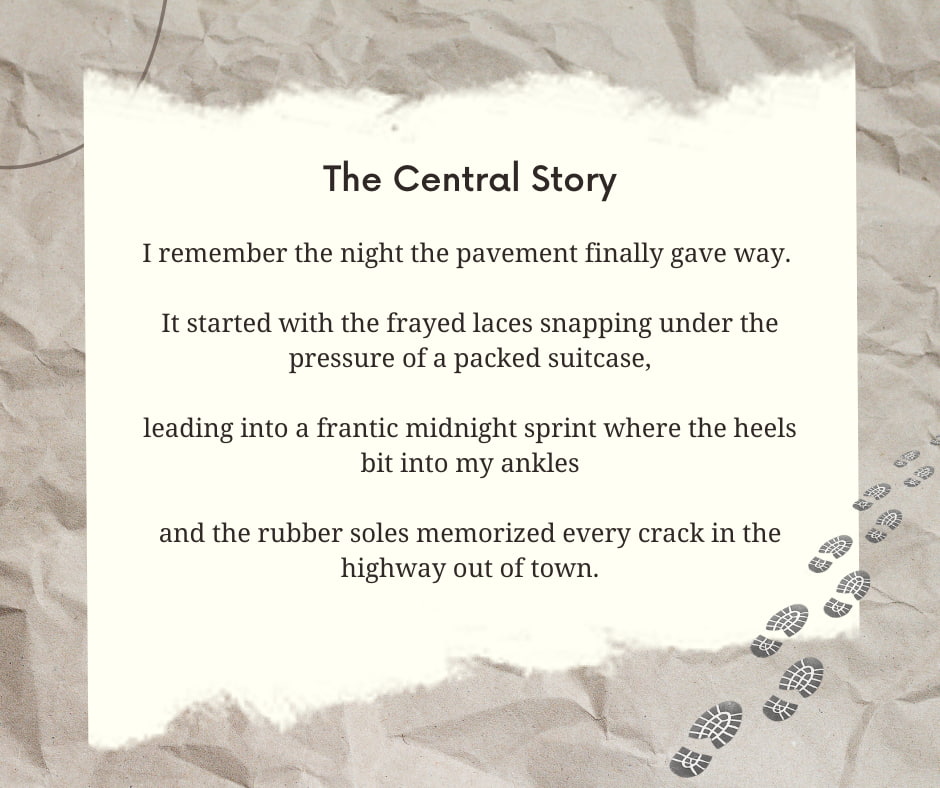
- Build a story around your central idea: Spoken word poetry relies on strong storytelling to keep the audience engaged. So in this step, you need to take the disconnected thoughts in your sensory map and start developing interesting characters, concepts, or experiences that take the room on a deliberate journey. Arrange these ideas in a logical, sequential timeline so listeners can easily follow your progression from beginning to end. As you map out this sequence, focus on specific details that do double duty: they should instantly capture attention while deepening the underlying meaning of your gateway line.
Applying this to our poem:
To turn our gateway line into an easy-to-follow story, we will arrange our ideas into a simple past-to-present timeline:
- Beginning (Present): Looking at the old shoes in the closet.
- Middle (Past Flashback): The frantic, midnight sprint out of town.
- End (Present): Looking at who we are today because of that choice.
Now, we write lines that show this sequence, matching the physical toll on the shoes to the emotional toll on the person:
- Create vivid imagery with literary devices: Once you have a story in place, use literary devices to bring it to life. Your goal here is to help the audience see, hear, feel, taste, and smell the world you’re creating. By using such strong imagery, you’ll be able to turn your poem from something listeners hear into something they experience.
Some of the most effective techniques you can use include:
- Metaphors and similes to create memorable comparisons.
- Personification to give life and emotion to non-human things.
- Wordplay and alliteration to make lines more engaging and memorable.
- Repetition and refrains to reinforce important ideas and images.
- Irony or unexpected twists to surprise the audience and deepen your message.
Applying this to our poem:
Let’s take the midnight run from our story and improve it using these exact techniques:
- Simile: “The midnight air tasted like exhaust and rain as the laces frayed like loose nerves.“
- Personification: “The concrete screamed under my weight…“
- Strong diction and wordplay: Instead of saying “I ran fast and felt scared,” we use rhythmic words: “The rubber soles engaged in a frantic squeak-slap against the highway, a tornado of adrenaline ravishing my chest.”
- The unexpected twist: We reveal who we were actually running from: “I wasn’t running from a monster in the dark. I was running from the terrifying thought of becoming comfortable in a town that prefers its ghosts quiet.“
- Texture your text for the ear: Spoken word is written to be spoken, meaning how your poem sounds is just as critical as what it means. You can give your writing a highly sophisticated, creative feel by experimenting with rhythmic devices, such as:
- Unexpected rhymes: Unlike closed forms of poetry, spoken word doesn’t require a strict, predictable rhyme scheme. In fact, hiding your rhymes in unexpected places is a much better way to place heavy emphasis on your key points.
- Sonic devices: Introduce a musical, rhythmic beat to your delivery by playing with alliteration, onomatopoeia, and assonance.
- The refrain: Repeating a specific line or phrase acts like the chorus of a song, which can create an anchor that makes it stick in a listener’s mind.
Applying this to our poem:
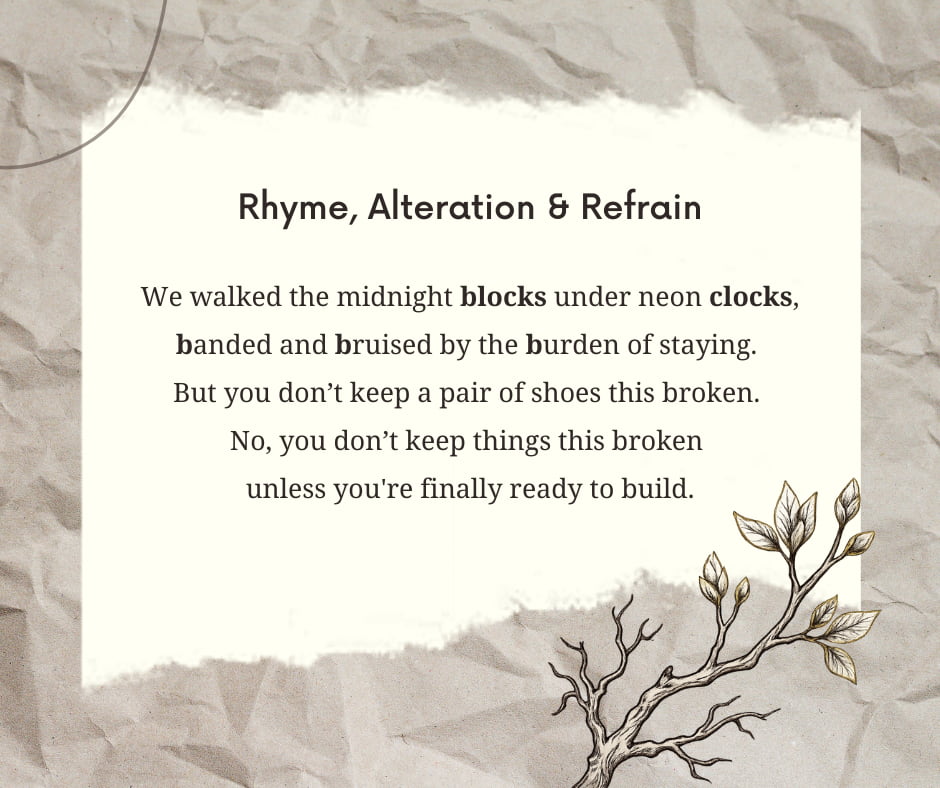
Let’s add a section right after our unexpected twist that uses internal rhymes, heavy alliteration, and a rhythmic refrain to give the poem an audible bounce:
- Unexpected/internal rhyme: Matching clocks and blocks.
- Alliteration: Repeating the heavy “B” sound to mimic a heartbeat or heavy footsteps.
- The refrain: Reintroducing a variation of our gateway line to anchor the theme.
- Conclude with a lasting impression: Your conclusion should neatly wrap up your storyline or leave the room with a lingering, haunting thought. Whether you choose an ending of hope, pain, or a lesson learned, it must tie directly back into your poem’s global message.
So when drafting your final lines, ask yourself: What should the audience take away? What should they know about me when the microphone turns off? You don’t need a clean, happy ending, but you absolutely need one that creates an indelible mark on the listener.
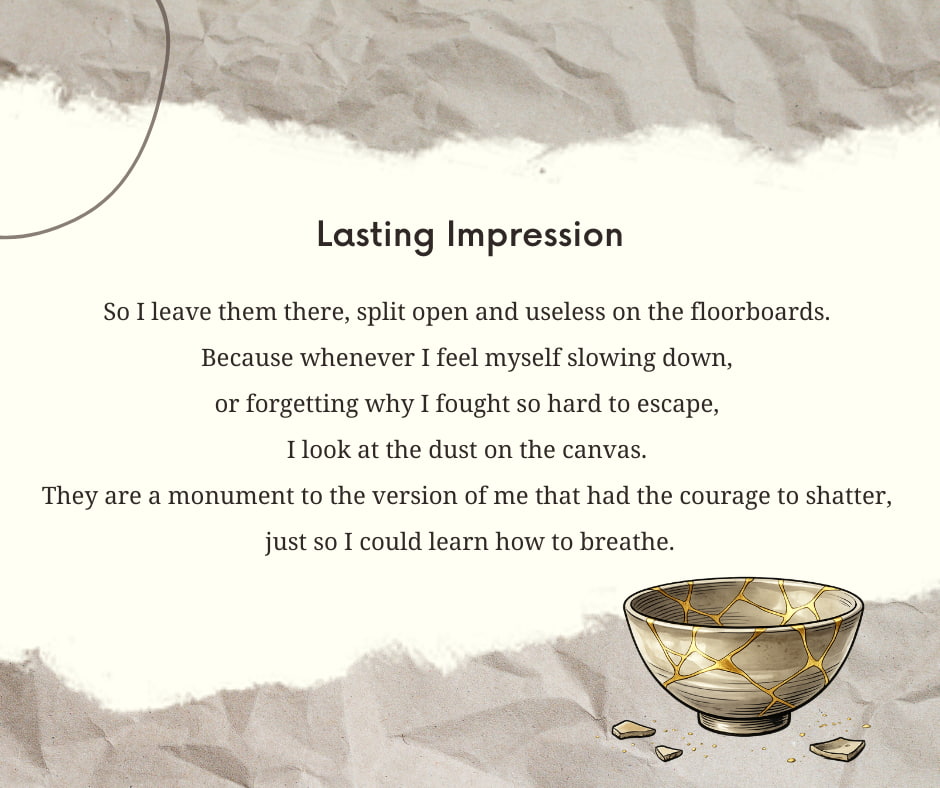
Applying it to our poem: To complete our Past-to-Present timeline, we bring the audience back to the present day to deliver our lesson learned. We answer exactly why we still keep those broken sneakers in our closet, leaving the crowd with a powerful final image:
Step Three: Editing and Polishing the Poem
Writing a first draft is like digging raw clay out of the ground; editing is where you actually sculpt it into art. Once you have your ideas on paper, use the following techniques to refine your words and smooth out your narrative flow:
- Step away from the page: After your messy first draft is finished, walk away from it. Because when you are deeply caught up in the raw emotion of writing a piece, it is easy to lose perspective on how the words actually sound to an outsider.
Putting your poem aside for a few hours, or even a couple of days, allows your emotions to settle. So when you return with fresh eyes, you’ll have the clarity needed to spot areas that can be written better, notice new insights you missed before, and refine how your message will ultimately land with your audience.
- Reorganize and restructure for better flow: When you return to your draft, look at it from a structural bird’s-eye view. Read through your poem and decide if your sentences and ideas are actually unfolding in the most logical and impactful order.
Do not be afraid to cut parts or rearrange your text. Moving a powerful sentence or shifting an entire verse to a completely different section of the poem is a common practice that can drastically improve your story’s flow, build better suspense, and maximize emotional impact.
Applying it to our poem: Let’s look at the middle section (the flashback narrative) of our poem when it was first scribbled down during a raw stream-of-consciousness dump. Notice how the ideas are all there, but splitting the action across separate blocks and leaving the emotional truth isolated at the bottom kills the suspense:
- The Messy Draft (Disorganized Order): “I remember the night the pavement finally gave way. It started with the frayed laces snapping under the pressure of a packed suitcase… [Action Part 1]
The midnight air tasted like exhaust and rain… a tornado of adrenaline ravishing my chest. [Action Part 2]
I wasn’t running from a monster in the dark. I was running from the terrifying thought of becoming comfortable in a town that prefers its ghosts quiet.” [The Emotional Reveal] - The Problem: By breaking the physical run into two separate chunks and delaying the explanation until the bottom, the momentum stutters. The audience gets a break in the action before they ever find out why the persona is sprinting down a highway at midnight.
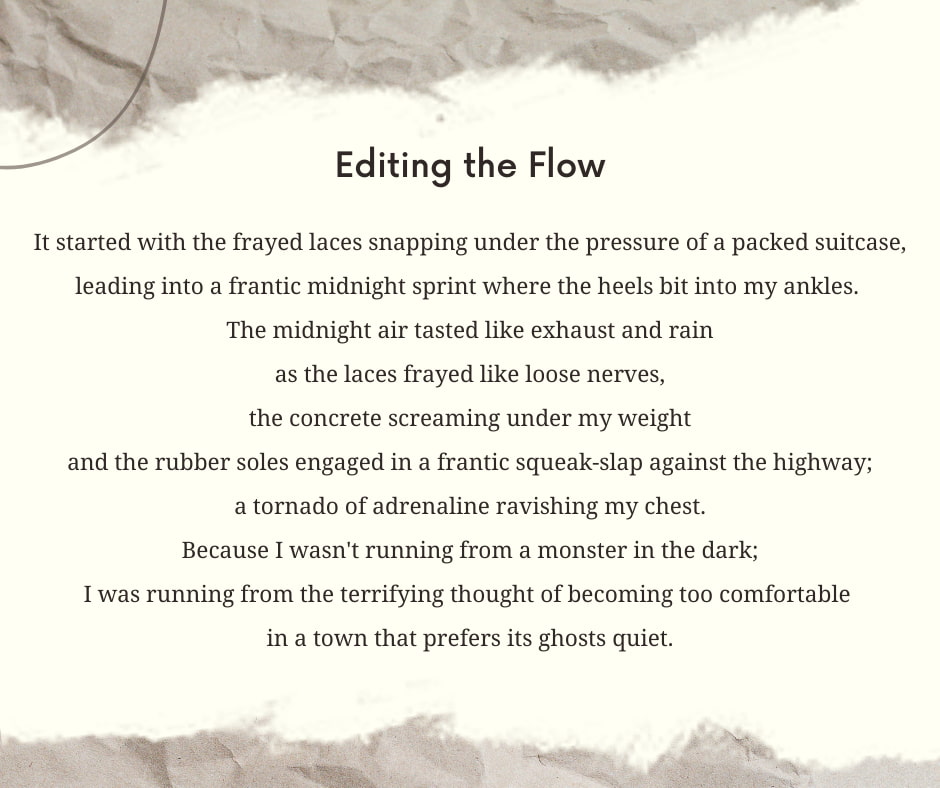
- The Restructured Version: To fix the flow, we can merge the best sensory details of the run into one continuous part. Then, we place the emotional revelation directly at the end of that sentence, turning it into a powerful punchline:
- Polish the script: Once your structure is locked in and your timeline makes sense, it’s time to move from macro restructuring to micro polishing. This is where you look at your text line by line to sharpen the language, cut the dead weight, and ensure every word earns its place on the stage.
- Kill the filler words: In written essays, we often use conversational safety nets like just, actually, basically, very, or suddenly. In spoken word, these words dilute your rhythm. Scan your poem and ruthlessly cut any words that don’t add direct sensory weight or emotional value.
- Elevate cliché metaphors: If you catch yourself using common phrases like “crying a river” or “heavy as a rock,” pause and rewrite them using the unique context of your poem. For example, instead of saying your heart was “heavy,” tie it back to our central theme: “My chest felt like a suitcase packed past its weight limit.”
- Listen for mechanical typos: Because spoken word is an oral art form, a minor word mix-up can completely derail the meaning of a line when spoken aloud. Read your poem out loud, specifically to catch words that sound right but mean something entirely different.
Applying this to our poem:
If you look closely at the draft we just assembled, it feels incredibly strong, but it still has a couple of hidden flaws that a sharp polish will fix. Let’s look at the third stanza from our draft:
“The midnight air tasted like exhaust and rain
as the laces frayed like loose nerves.
The concrete screamed under my weight…
The rubber soles engaged in a frantic squeak-slap against the highway,
a tornado of adrenaline ravishing my chest.”
The Polish:
- Repetitive language: We used the word “frayed” twice in the exact same breath (laces frayed / frayed like loose nerves). Let’s change the first mention to “unraveled” to keep the vocabulary dynamic.
- The mechanical error: Look at the word ravishing in the final line. While it sounds dramatic, ravishing means unusual beauty or being captured by force. The word we actually want for a destructive, tearing storm is ravaging.
The Final Polished Lines:
“The midnight air tasted like exhaust and rain
as the laces unraveled like loose nerves.
The concrete screamed under my weight…
and the rubber soles engaged in a frantic squeak-slap against the highway,
a tornado of adrenaline ravaging my chest.”
Step 4: Writing for the Stage
Because spoken word is an oral art form, the writing process doesn’t truly end until the words leave your mouth. That’s why it’s important to format and test your writing against these three performance rules:
- Format your line breaks for breath: When finalizing your text, forget about standard grammatical punctuation rules. On stage, a line break is a physical cue to inhale or let a heavy image hang in the air. So break your lines exactly where you want a natural pause to happen. Remember that short, isolated words create a tense, rapid heartbeat rhythm, while long, unbroken lines allow you to build an unstoppable wave of momentum.
- Write your delivery cues: Treat your poem like sheet music. In the margins of your page, write delivery notes to yourself. For instance, jot down [Speed up] during high-intensity moments (like our frantic midnight sprint) to build a sense of panic, or write [Whisper] when delivering a core revelation (like the “quiet ghosts” line) to force the crowd to lean in closely.
- Memorize your lines: Memorization can be intimidating, but standing on stage holding a piece of paper or a phone instantly builds a wall between you and the crowd. By committing your verses to memory, you’ll be able to use your hands, posture, and direct eye contact to physically live out the emotions of the poem.
Bringing Your Spoken Word Poetry to Life with Kotobee
Writing a spoken word poem is an incredible achievement, but because this art form is meant to be heard and seen, publishing it as a traditional, flat-text ebook leaves half the magic behind. This is where using an interactive ebook software, such as Kotobee, to create your spoken-word poetry ebook can be a game-changer.

By utilizing Kotobee’s interactive features, you can bridge the gap between the page and the stage; it allows you to create a multimedia poetry collection that lets your audience experience your poems exactly as you intended. This can be done through one of the following options:
- Add audio narration: Since spoken word poetry relies heavily on pacing, pauses, and vocal inflection, you shouldn’t just hope the reader guesses your rhythm; instead, you can embed your own audio narration directly into the page.
- Use synchronized audio: To take that listening experience a step further, you can synchronize your recorded audio directly with your text. As your voice reads the poem, the corresponding words are highlighted in real-time on the reader’s screen. This ensures your audience catches every bit of emphasis, every dramatic pause, and the exact flow of your delivery as they read along.
- Embed video performance: By adding a video of yourself performing the piece right under the text, you give your audience the ultimate dual experience: they can read the lines on the page and then immediately hit play to watch the poem come to life under the spotlight. By doing so, you’ll be transforming your ebook into a digital front-row seat to your live performance.
Concluding Thoughts
Spoken word poetry is an open invitation for someone else to step inside your world, your heart, and your rhythm. It demands courage to take your private thoughts from a quiet notebook page, shape them into a performance script, and share them out loud.
But you don’t have to wait for a physical stage to find your audience. By pairing your raw writing with modern, interactive media, you can ensure your words never have to sit quietly in black and white again. The framework is in your hands, the digital spotlight is waiting, and the microphone is open. Go share your truth!
More from Our Blog
Every self-publisher, educator, and independent author shares a common, nagging…
Choosing a SCORM authoring tool is all about finding the…
The way we find our next read is no longer…

