

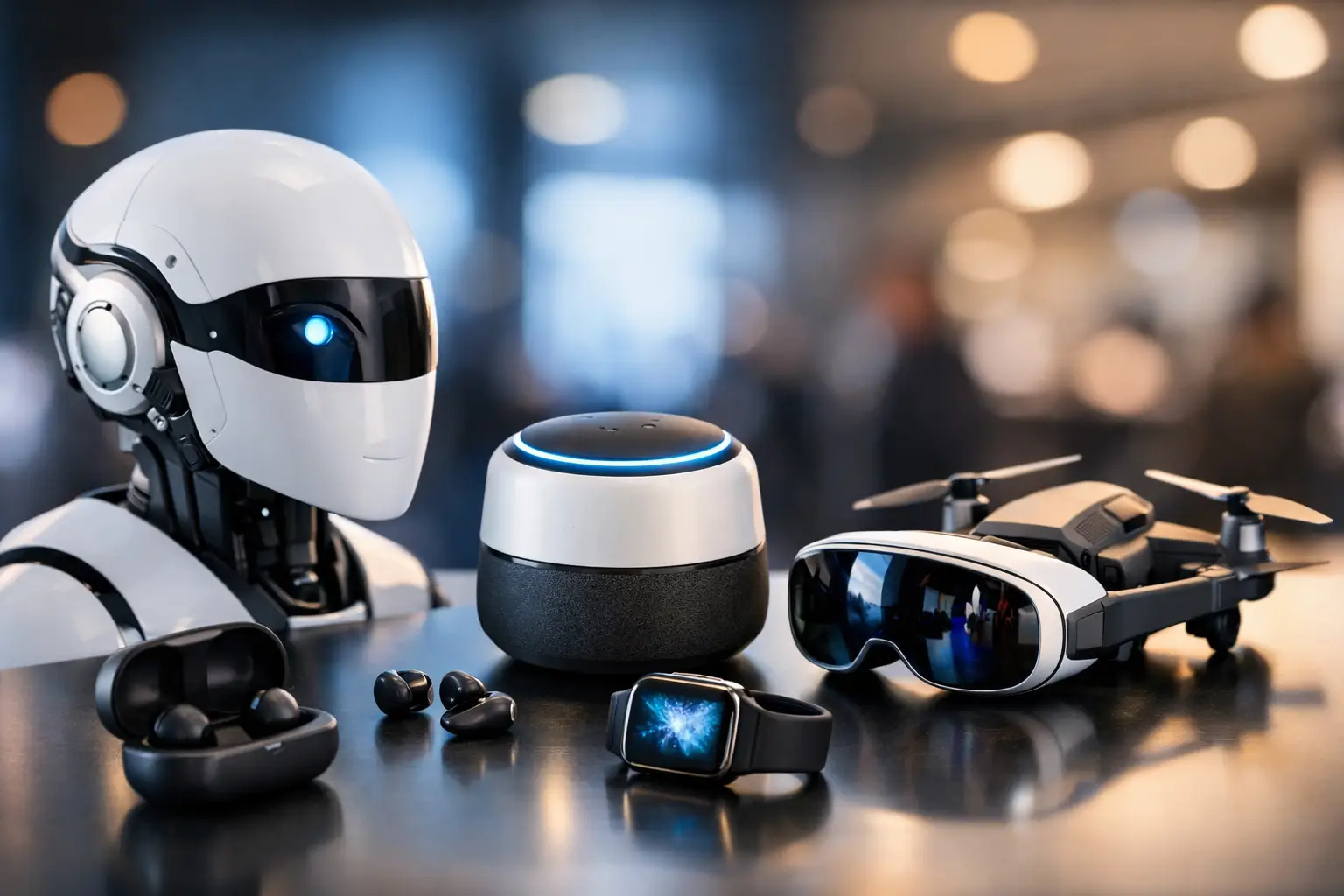
The latest AI gadget launches are no longer just about showing off clever demos on a stage. They are starting to answer a simpler question: what would make daily life quicker, easier or a bit less screen-heavy? That shift matters, because consumers have seen enough concept videos. What they want now is hardware that feels useful the moment it leaves the box.
For the past year, AI has been squeezed into nearly every tech announcement, but gadgets have had a mixed record. Some devices promise a phone replacement and end up feeling half-finished. Others look modest at first, then quietly become the category to watch. Right now, the market is moving fast, but not every launch deserves the same level of hype.
Why the latest AI gadget launches feel different
Earlier waves of smart devices were built around apps, notifications and cloud syncing. The latest AI gadget launches are pushing a different pitch. They want to be more conversational, more aware of context and, in some cases, less dependent on staring at a display.
That has opened the door for several kinds of product. Smart glasses are aiming to bring assistants, cameras and audio into something wearable. AI pins and clip-on devices are trying to offer voice-first help without a phone taking centre stage. Then there are upgraded earbuds, home assistants and laptops that use on-device AI to handle transcription, summaries, image generation and search.
The big change is that companies are no longer selling AI as one feature hidden in settings. They are building the entire gadget story around it. That makes launches easier to understand, but it also raises the bar. If a product is marketed mainly as an AI device, people expect the AI to work brilliantly every day, not just during a polished demo.
Smart glasses are leading the conversation
Among the latest AI gadget launches, smart glasses have generated the most mainstream interest. That is partly because they are easier to explain. Most people already understand glasses, cameras, microphones and audio. Add useful voice controls and live assistance, and the product starts to sound practical rather than futuristic.
The strongest appeal is convenience. You can ask questions, take photos, hear directions or translate speech without pulling out your handset. For commuting, walking through a city or even cooking at home, that hands-free element makes sense.
But there is a trade-off. Battery life remains a sticking point, and privacy concerns have not disappeared. A wearable camera in public spaces still makes some people uneasy, and brands will need to prove that these gadgets are not intrusive. Price is another factor. For many shoppers, smart glasses still sit in the category of interesting rather than essential.
Even so, this is the segment that currently looks closest to broad consumer adoption. The reason is simple: it fits into an existing habit. People already wear glasses or sunglasses. They do not have to learn a whole new behaviour to see the value.
What smart glasses do well
They work best for quick tasks. Capturing a moment, getting spoken directions, listening to messages or asking for fast information all feel natural on eyewear. These are bite-sized interactions, and that suits current AI tools well.
They are less convincing when brands position them as a complete smartphone replacement. Most consumers are not ready to give up a large screen, familiar apps and the reliability of a phone. Smart glasses can be a strong companion device. Replacing everything is a much harder sell.
AI pins and screen-light gadgets still have a lot to prove
If smart glasses feel like an upgrade to something familiar, AI pins feel like a genuine experiment. That is part of the attraction and part of the problem.
These devices are designed around voice, context and quick assistance. In theory, you clip one to your clothing and ask it to handle messages, queries, reminders and live information. It sounds neat, especially for people tired of constant screen time. In practice, the category has struggled with speed, accuracy and the basic question of why it deserves pocket space.
That does not mean the idea is finished. It means the current versions have highlighted how difficult it is to build a gadget around AI alone. If responses are slow, if voice recognition misses the point, or if basic tasks still push you back to your phone, the product loses its edge fast.
This is where hype can damage a launch. A device framed as the next big thing will be judged harshly if it feels like a work in progress. Consumers are more forgiving when a product is pitched as an interesting helper. They are less forgiving when it is pitched as the future and behaves like a beta test.
Earbuds, laptops and home tech may be the real winners
Some of the smartest moves in the latest AI gadget launches are not coming from headline-grabbing wearables at all. They are coming from familiar devices that are quietly getting better.
Earbuds with live translation, voice cleanup and better assistant access have a strong chance of sticking because they fit into routines people already have. Laptops with built-in AI features for work, study and content creation are also easier to justify. If a device saves time on emails, notes, image editing or meetings, buyers can quickly see the return.
Home gadgets are another area to watch. Smart displays, speakers and security devices are being updated with more natural language processing and better recognition of household habits. When these features work well, they feel less like gimmicks and more like small quality-of-life upgrades.
There is a broader lesson here. AI hardware often works best when it improves an existing category, not when it tries to invent a completely new one overnight. Consumers tend to trust evolution more than disruption, especially when money is tight.
What buyers should watch before jumping in
The current wave of launches is exciting, but buying early still comes with risk. The first thing to check is whether the device relies heavily on cloud processing or can handle some tasks on-device. On-device AI can mean faster responses, better privacy and fewer problems when the connection drops.
Battery life should not be treated as a side note. A gadget that promises all-day help but needs charging after a few hours quickly becomes annoying. The same goes for heat, comfort and app support. Wearable tech has to be genuinely wearable, not just clever.
It is also worth looking at subscription costs. Some AI gadgets are priced to look competitive, then add premium features behind monthly plans. That can change the real cost quite sharply over a year.
Another key point is software support. A lot of AI gadgets improve through updates, but that only helps if the maker has a strong track record. A brilliant launch can lose value quickly if the company slows down development or changes direction.
Questions worth asking before you buy
Does it save time in a way your phone cannot? Does it fit naturally into your day? And will you still use it after the novelty wears off? Those questions are more useful than any flashy keynote claim.
The biggest trend behind all of this
The most interesting thing about the latest AI gadget launches is not one specific product. It is the direction of travel. Tech firms are trying to make computing feel more ambient – less typing, less tapping, more listening and responding.
That idea is compelling, but it is not guaranteed to work in every form. Plenty of people still prefer screens for accuracy, privacy and control. Voice interfaces can be brilliant in the right setting and awkward in the wrong one. Asking a wearable for directions while walking is one thing. Dictating personal messages on a packed train is another.
So the future here probably is not one winner taking everything. It is more likely a mix of devices doing different jobs well. Glasses may handle hands-free moments. Earbuds may deal with language and calls. Laptops may take care of work tasks. Phones are unlikely to disappear soon, but they may become less central in certain everyday interactions.
For a broad audience keeping an eye on consumer tech, the smartest approach is to stay curious but selective. Some launches will fade once the excitement dies down. Others will quietly shape how people shop, travel, work and communicate over the next few years. If a gadget can fit into real life without demanding too much compromise, that is usually the one worth remembering.
The next big AI device may not be the loudest launch of the year – it may be the one that feels normal fastest.

