


(Note: For those unfortunate few who hate soccer, you can just skip to the next post—and you are missing one of the world’s greatest sporting events.)
Like more than 30 million other Americans, last night I watched the U.S. Men’s National Team (USMNT) defeat Bosnia and Herzegovina 2-0 at the FIFA World Cup.™ The big talking point after the game was whether the “straight” (i.e., immediate) red card given to the American striker, Folarin Balogun, was correct. As a long-time fan of the U.S. men’s team (and the women’s team, see, e.g., my post here), it may not be a surprise that I disagree with the call. And I acknowledge that I lack formal training in the rules of the World Cup. But as a lawyer and former trial court judge, I do have training and experience in applying rules to specific fact patterns. That background leads to me question the decision last night. Because it is interesting to think about how legal rules apply in this situation, I thought a short blog might be appropriate and timely.
To briefly recap the situation, last night at about 63 minutes into the match, the USMNT was leading the Bosnian team 1-0. Then American striker Balogun and Bosnian defender Tarik Muharemovic came together as they competed to claim a ball high in the air. You watch video of the incident here. As Balogun came down, the studs on his boot (e.g., his right cleat) landed on the ankle of Muharemovic. The referee on the field called nothing. But after the Video Assistant Referee (VAR) looked at incident in slow-motion, he called the referee to review the images. After slow motion review of the video, the referee changed his earlier call and gave Balogun a red card for “serious foul play.” This red card means Balogun was ejected from the game—and he will now miss the USMNT’s next game against Belgium on Monday.
As a lawyer considering the red card, four concerns come quickly to mind:
The “Time Framing” Problem
In law, a common issue is deciding the appropriate time frame to assess a disputed action. In criminal law, for example, a defendant’s actions may look culpable if one focuses on a narrow point in time. But stepping back and viewing the situation more broadly places the conduct in a different light. A simple illustration is that a defendant shooting a person might look like murder, if analyzed exclusively by focusing at the time the shot was fired. But rewinding time and learning that a few seconds earlier the person killed had made serious and plausible deadly threat to the defendant, the defendant’s action might be reasonable self-defense. Selecting the right time frame is critical.
Applied to Balogun’s situation, the time framing issue is whether to assess the correctness of the red card at the time he landed on the defender’s ankle—or earlier. Almost by definition, the assessment must involve a broader time frame then when Balogun landed. To offer simple hypothetical example, suppose Balogun had jumped straight up in the air to try and win the ball and the defendant had deliberately placed his ankle under Balogun to draw a red card. Focusing just on the landing would provide a misleading impression.
In Balogun’s situation, the issue of whether he engaged in serious foul play would seem to turn on the time at which he launched his jump. Thereafter, of course, his ability to change his trajectory would be very limited. And yet, according to the American televised broadcast, the VAR officials and referee appeared to focus on the time at which he landed.
The time framing problem becomes even more substantial when we consider what happened after Balogun’s launch and during his jump. As shown in the image below, the defender arm is extended into Balogun, clearly changing the trajectory of his jump.
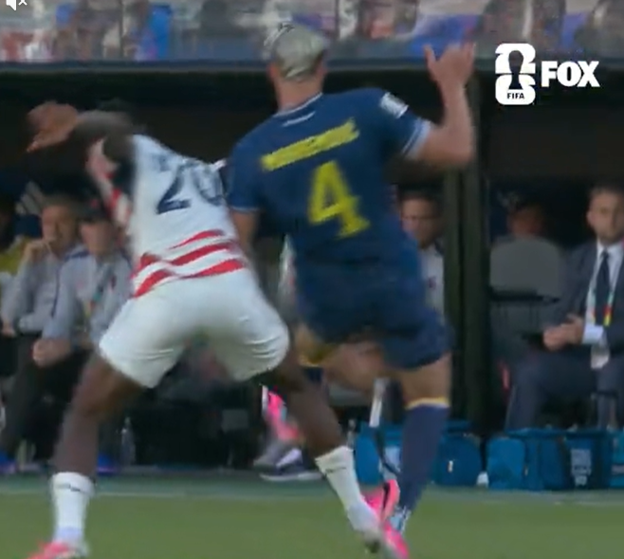
Of course, if Balogun was knocked off balance by the Bosnian player, that would seem to place the incident in a different light.
But the commentary that I’ve read on the incident doesn’t discuss this fact. And it is noteworthy that the rules of soccer (promulgated by the International Football Association Board or IFAB) only allow shoulder-to-shoulder challenges, not use of the arm. See IFAB Rule 12 (“A player may shield the ball by taking a position between an opponent and the ball if the ball is within playing distance and the opponent is not held off with the arms of body.”) Considering this fact of illegal arm contact by the Bosnian defender preceding Balogun’s boot to the ankle changes the situation, as Balogun could not have reasonable understood he was going to be pushed by the defender in that way.
Mens rea or intent
This last point leads swiftly into another consideration: what was Balogun’s intent? In criminal law, the Latin shorthand for such considerations is “mens rea,” translated roughly as “guilty mind.” The applicable provision (Rule 12) from the IFAB Rules of Soccer provides:
“Any player who lunges at an opponent in challenging for the ball from the front, from the side or from behind using one or both legs, with excessive force or endangers the safety of an opponent is guilty of serious foul play.”
In criminal law, a common interpretive question when construing provisions like this is to what extent they contain a mens rea requirement. The standard answer in criminal law is that the defendant typically must have some mens rea with respect to his actions, typically either intentionality, knowledge, or recklessness. Only in rare situations is a defendant guilty without intent—situations described as “strict liability.”
The serious foul play rule, at least as drafted, does seem to raise the possibility that intent is irrelevant. In particular, the phrase “endangers the safety of an opponent” could be interpreted as creating red card liability for simply creating an objectively dangerous situation. But context would still remain important in interpreting the phrase “endangers.” Consider, for example, the hypothetical situation of player jumping to head the ball and being pushed in the back by the opposing team as he comes down—with the effect that he lands on and, thus, endangers an opponent. No red card would appear to be appropriate in that situation, as the player is not in control as he lands through no fault of his own. It would be hard to describe the mere act of jumping in the area of an opponent as “endangering” an opponent.
This concept is implicit in the IFAB rules, but is made more explicit in other rules interpreting them. For example, the English Premier League (widely regarded as the best soccer or “football” league in the world) specifically lists five considerations for a “serious foul play” red card determination:
- Speed
- Intensity
- Force
- Degree of control
- Point and extent of contact (full/limited)
Thus, a player who makes a controlled challenge that inadvertently and unexpectedly endangers an opponent might not be guilty of a red card offense.
Similarly, as a matter of common sense, the degree of endangerment will always need to be considered when issuing a red card. Anyone on a soccer field fighting to win balls will, to some degree, endanger the safety of the opponent. The degree of endangerment becomes important, and someone who is intentionally trying to harm an opponent will, presumably, be more likely to cross that threshold.
This conclusion is reinforced by other events during the World Cup, such as an earlier incident involving the world’s most famous soccer player, Lionel Messi The incident clearly endangered the safety of an opponent but was not deemed worthy of a red card (or even a foul). The picture below shows the event:
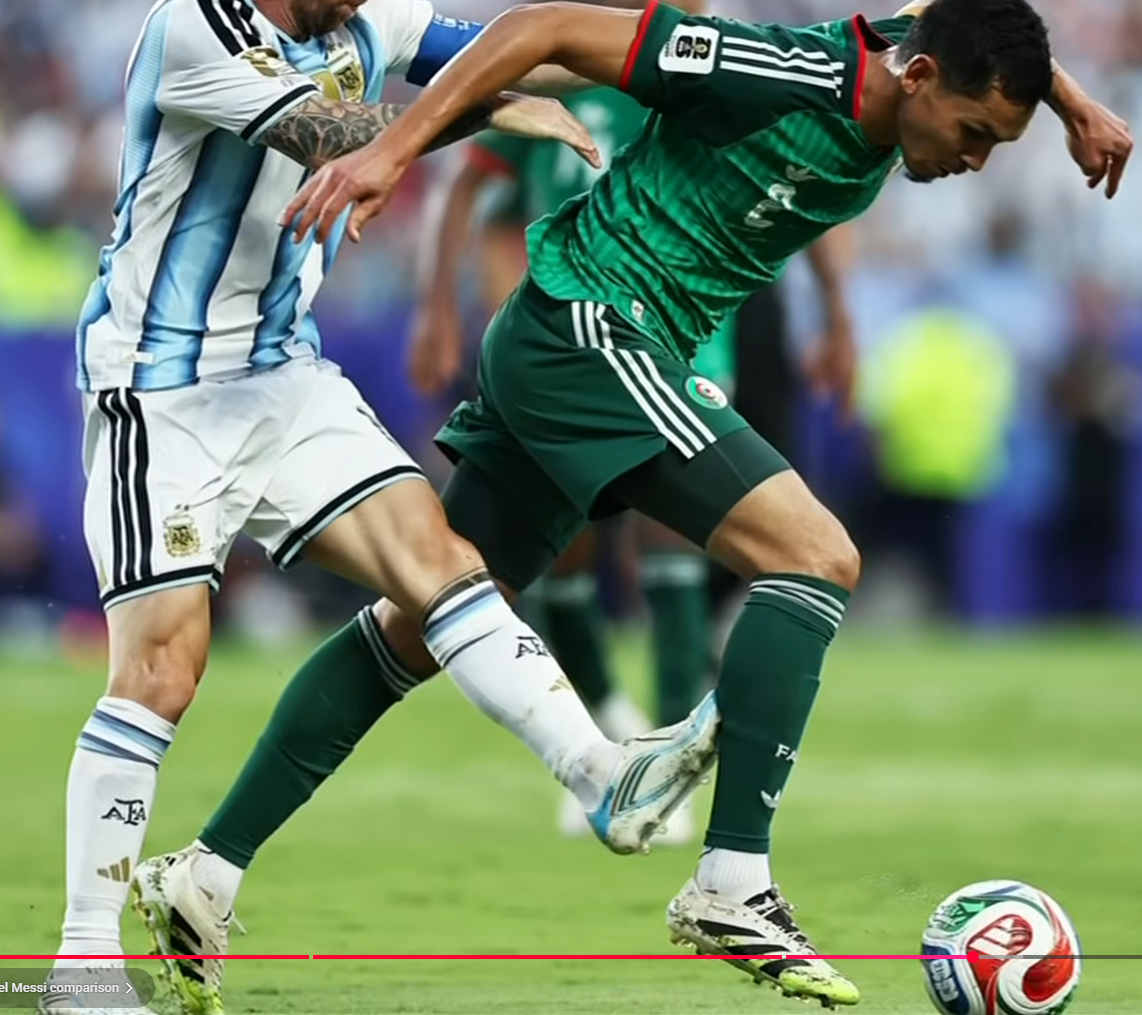
As I understand things, the reason that Messi was not called for even a foul was that the contact was unintentional and therefore could not be said to rise to the level of endangerment. So too, it would seem, with Balogun’s contact.
Many commentators have criticized the Balogun red card on grounds that it involved unintentional conduct, including former Premier League referee Mark Clattenburg here, former Select Group referee Andy Davis here. Which leads me to the next legal concern:
Standard of Review
The debate over the Balogun red card leads directly into another standard legal question: What is the standard of review for an on-the-field determination? Recall that, on the field, the referee did not even whistle Balogun for a foul, let alone a yellow card, let alone a red card. What standard of review is applied in deciding whether to overturn the initial decision?
Here, the IFAB Rules of Soccer are clear. IFAB’s “Video Assistant Referee (VAR) Protocol” provides that a potential missed red card situation can be reviewed and changed, but only if the error is “clear and obvious.” Here is the relevant language of the VAR Protocol:
The original decision given by the referee will not be changed unless the video review clearly shows that the decision was a “clear and obvious error.”
The undergirding principle behind this rule is to avoid disrupting the flow of the game. VAR is already controversial because of the delays involved. So this standard of review is no mere technicality, but part of keeping the “beautiful game” beautiful.
Often at the World Cup, application of the “clear and obvious” principle is straightforward. For example, VAR has semi-automated technology that shows the relevant positions of the attackers and defenders at the time of a pass, allowing incontrovertible evidence of whether a player was “offside” during an attack. But on judgment calls such whether some action was serious foul play, issues become more subjective.
And given that subjectivity, the fact that there is genuine dispute by neutral observers over a call would seem to rapidly remove it from the “clear and obvious” error category. If neutral and skilled soccer observers (such as Clattenburg and Davis) disagree with the call, it is hard to believe that the error was, in fact, “clear and obvious.”
Appeals Process
So Balogun’s red card was incorrect, at least in my view, as I have outlined here. Can there by an appeal—particularly of the one-game suspension that followed Balogun’s ejection from last night’s game?
It appears to be that under the FIFA World Cup rules, no appeal by the U.S. is possible from the suspension but FIFA’s disciplinary committee could extend the one-game suspension to additional games. I don’t dispute the no-appeal rule is currently in effect and needs to be followed in Balogun’s case. But I do want to suggest that. from a legal perspective, this one-way rachet allowing an increase in the punishment but not a decrease is ill-conceived.
For starters, it is useful to think about why a one-game suspension is added onto the (already severe) punishment inherent in a red card of a ejection from a game. On reflection, the reason is obvious. Without such an suspension add-on, the end of soccer matches would become open-season on players; a losing team, for example, could simply hack down opposing players, as the ejection from a game that was already a lost cause is no real punishment at all.
So given that the purpose of the additional, one-game suspension rule is its deterrent effect, how does the no-appeal-of-a-suspension fit into that purpose? In my view, the appeal rule should be broadened to allow an appeal by a suspended player. This change would not produce any substantial reduction in the deterrent value of the suspension rule. For example, it is impossible to believe that Balogun’s calculations regarding his challenge on the Bosnian defender considered the absence of an appeal as part of the calculus.
And allowing appeals by a suspended player’s team would help improve the accuracy of the process. Accuracy is, of course, one of the main reasons for an appellate process in the law. The general understanding in the law is that immediate, on-the-scene decisions (such as evidentiary rulings by trial court judges) may benefit from a detached, “second set of eyes” looking at the issue later. The same can be said of an appeals process for red card suspensions. An on-the-field decision might be erroneous and could be corrected by appeal. And the appeal process would have the benefit of being done without the time pressure inherent in an on-the-field decision. Since a suspension for the next game will, by definition, not apply for at least a few days, there is time for an appeal process—particularly in high stakes games like the World Cup games.
Another function of appeals in the law is to promote consistency from trial court to trial court. For example, appeals of criminal sentences are thought to help promote rule-of-law principles but ensuring that local decisions do not vary from jurisdiction to jurisdiction. The same could be said of appeals of red card suspensions. With this year’s World Cup spread across three countries and multiple referees from different nations, promoting consistency is an important goal.
From what I can tell reading the commentary about Balogun’s suspension, the biggest criticism has been how he was treated differently—and more harshly—than other similarly situated players, with the most prominent example being the leniency shown to the prominent (and popular) Lionel Messi. American soccer pundit Alexi Lalas, for example, has said that “if his [Balogun’s] name was Messi, he would still have played.” Without debating whether Lalas is right, the advantage of a centralized and consistent appeals process to potentially address such claims seems apparent.
To be sure, the new appeals process that I am proposing for suspended players would only operate to retract a suspension rather than give one. VAR already seems intrusive enough without allowing it to scan video of prior games and locate possible red cards. But there is no novelty is allowing appeals that operate in the direction of leniency only. In the U.S., for example, appeals by criminal defendants are routinely allowed by appeals appeals by prosecutors are rarity.
For all these reasons, my view is that Balogun’s red card card was incorrect and that, in the future, appeals of suspensions by the suspended players should be allowed. But as noted at the outset, I make no claim to being a professional interpreter of the rules of the game. And, of course, it is also possible that my views on this issue are shaped by my hopes that the U.S. men’s team progresses further in the tournament. If you have thoughts, feel free to add them to the comments below.

