


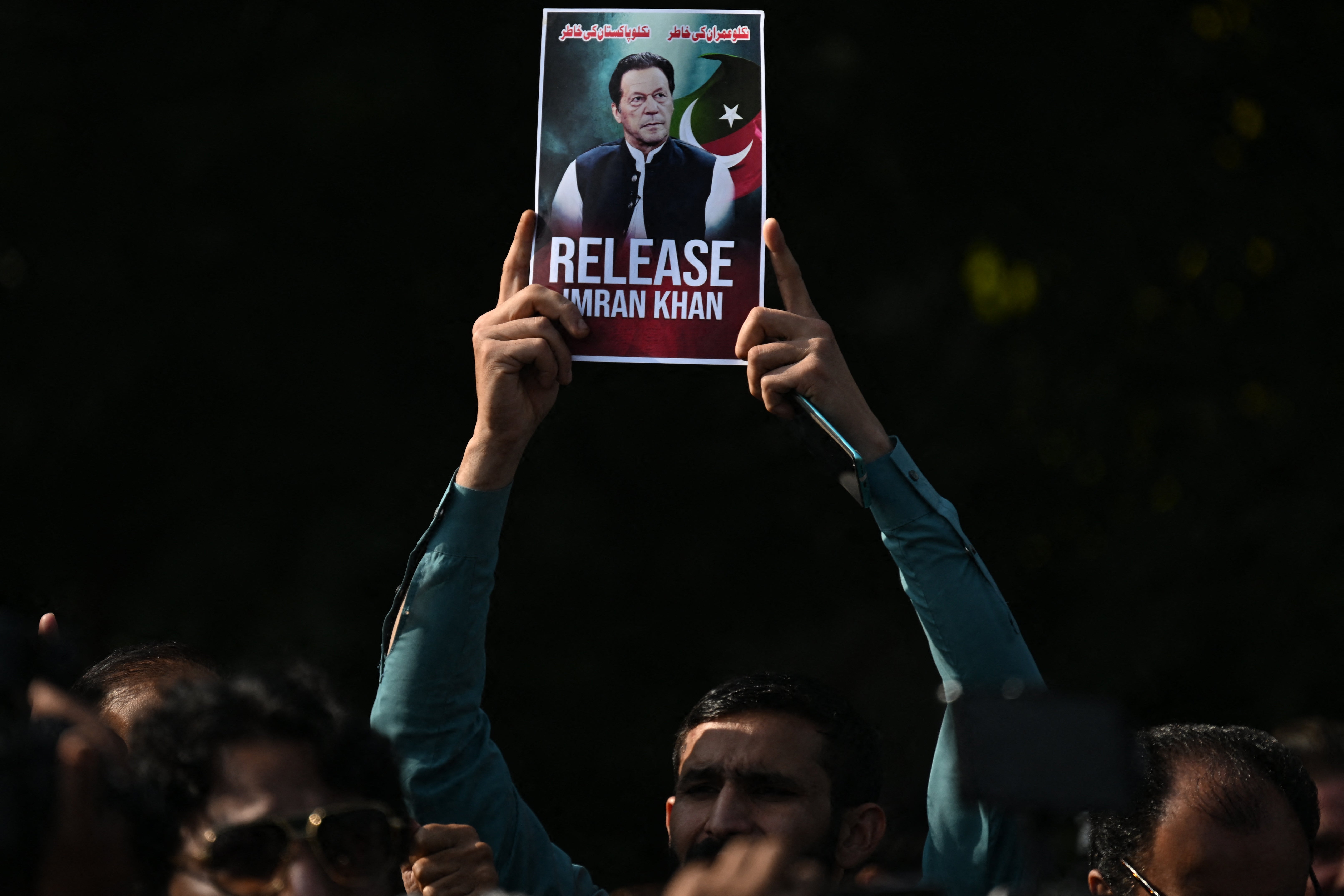
Human rights activists renewed calls to authorities to restore Imran Khan’s access to family, lawyers and medical care as the former Pakistan prime minister marked three years in prison on Wednesday,
Amnesty International urged authorities to end what it described as “unlawful” restrictions on his detention and demanded that Pakistani authorities “unconditionally restore Imran Khan and (his wife) Bushra Bibi Khan’s right to see their family and lawyers”.
In a statement issued ahead of the anniversary of Khan’s detention, Amnesty International said: “Both must be given access to adequate medical care and their solitary confinement, which is unlawful, should end immediately.”
Isabelle Lassee, Amnesty’s acting regional director for South Asia, said: “For three years, Pakistan’s authorities have systematically denied Imran Khan the right to a fair trial, subjected him to prolonged solitary confinement, and limited his access to medical care and visitation rights. He has not been allowed to meet his family for more than eight months and his vision has reportedly deteriorated significantly. Both he and his wife, Bushra Bibi Khan, have now been denied regular access to legal counsel since December 2025.”
Khan’s party, the Pakistan Tehreek-e-Insaf (PTI), said he has been in “complete isolation with no meetings whatsoever for over eight months now”.
Sayed Zulfikar Bukhari, Khan’s close aide, wrote on X recently: “Both he and his wife have a fundamental right to a fair trial and to the protection of basic prisoners’ rights. The situation is deeply concerning and dire for both of them.”
He told The Independent: “What has these three years achieved? Has Pakistan progressed in any sector or not regressed? Imran Khan today is more popular than he has ever been and the people of Pakistan recognise his stance is for them and a democratic Pakistan, despite all brutalities.”
Amnesty also urged Pakistan authorities to “facilitate the right to peaceful protest and ensure there is no repeat of the unlawful and arbitrary crackdowns on protesters” ahead of planned gatherings by Khan’s family, party and supporters to mark the anniversary.
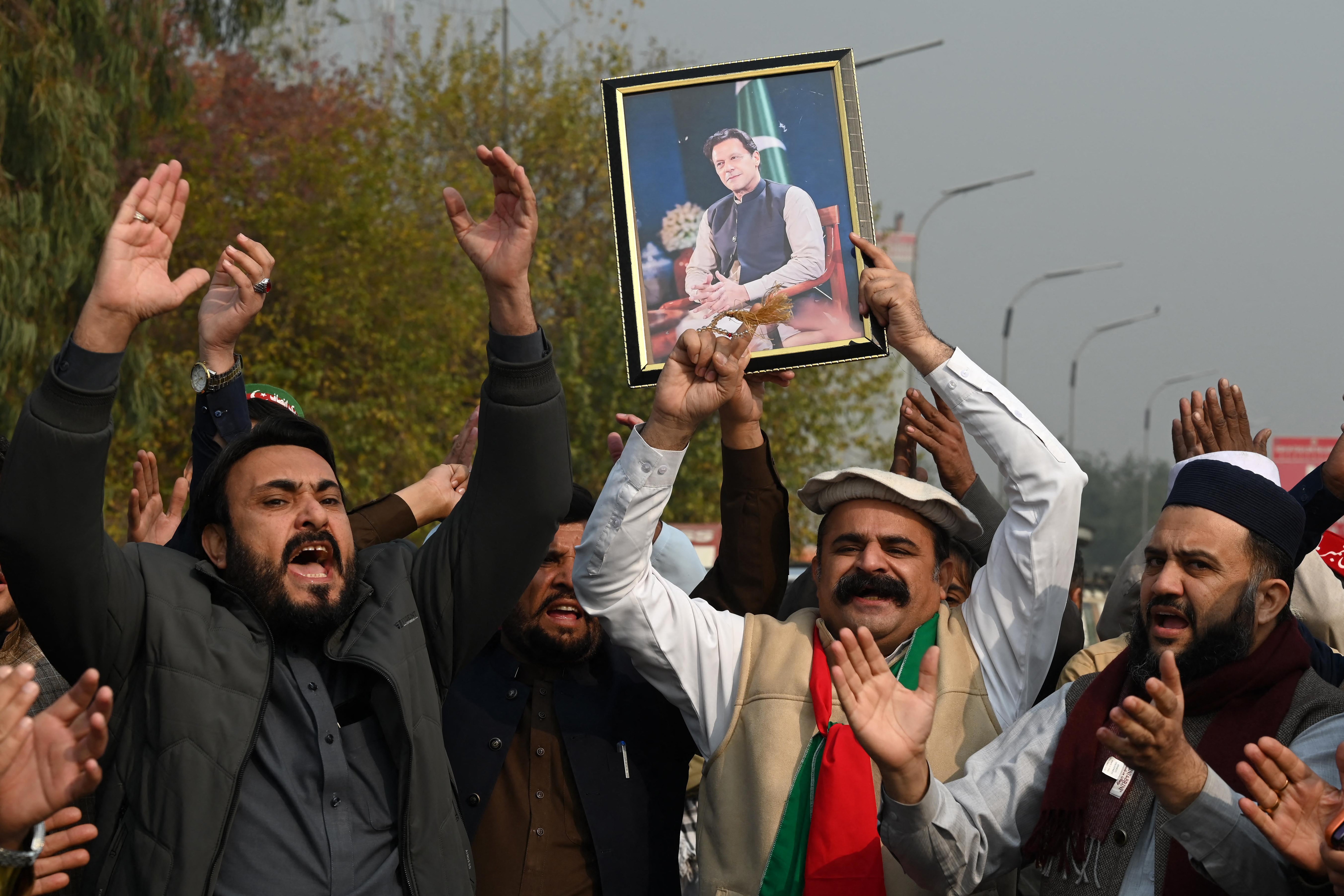
During his third year in prison, concerns have grown over Khan’s health as well and access to his family. Earlier this year, he was diagnosed with a blocked retinal vein in his right eye, a condition that can lead to significant vision loss.
His lawyer said delays in treatment left him with only about 15 per cent vision in the affected eye, although a government medical board later said his condition had improved.
Khan received five injections at a government hospital between January and June, while his family continued to press authorities to allow his personal doctors to examine him.
Khan, 72, has remained in custody since 5 August 2023 after previously being arrested during nationwide unrest in May that year.
The former cricket star was removed as prime minister in April 2022 following a parliamentary vote of no-confidence.
Although he has been acquitted in several cases, including those relating to official secrets and his marriage to Bushra Bibi, Khan is serving a 14-year prison sentence in a corruption case, while he and his wife were also sentenced in December 2025 in a separate case involving state gifts.
Both convictions are under appeal, and Khan has denied wrongdoing.
Khan’s sister, Aleema Khan, has also been touring towns across Pakistan’s Khyber Pakhtunkhwa province to rally support for the planned 5 August march to Adiala Jail, where the former prime minister is being held.
In 2024, the UN Working Group on Arbitrary Detention concluded that Khan’s imprisonment was arbitrary and violated international human rights law. The following year, the UN special rapporteur on torture expressed concern that the detention conditions of Khan and his wife fell below international standards.
More recently, a UN torture expert called on Pakistan to end its inhumane treatment of Khan.
Alice Jill Edwards, the UN special rapporteur on torture, said Khan had been held in near-total solitary confinement for 33 months under round-the-clock CCTV surveillance.
Pakistan’s government in 2024 submitted to the Supreme Court details of the living conditions of the former PM, seeking to rebuff his claim of mistreatment and of being held in solitary confinement without access to lawyers.
The government submission seen by Reuters included photographs of the cell that showed a collection of books including Nelson Mandela’s autobiography “Long Walk to Freedom”, apparently intended to highlight Khan’s freedom to read what he wishes in jail.
The submission also contained a list of family and friends, lawyers and party members who have seen Khan since he was jailed in 2023.
The pictures in the government submission showed a messy bedroom with a study table, a chair, a single bed, a cooler, a washbasin next to a washroom in the corner, with a flat TV screen hung on a wall. It shows shirts thrown on the back of the chair and trousers, pants and a towel hung on a wall.
Another picture shows a long walkway with a barracks on both sides, describing it as an “exclusive gallery for walk, twice a day.” Another shows what it says is a separate kitchen with condiments, one more showed a collection of books on Islam, history and politics, and other pictures show a room with an exercise bike and fitness equipment.
Despite his imprisonment, Khan has remained Pakistan’s most influential opposition figure.
Political analysts say his incarceration has strengthened his image among many supporters, particularly younger Pakistanis, who view him as a symbol of resistance to military interference in politics, Nikkei Asia reported.
Salman Rafi Sheikh, an assistant professor of politics at Lahore University of Management Sciences, told the outlet: “For many Pakistanis – especially a large part of the youth – he symbolises resistance to military interference in politics, and his incarceration has reinforced that narrative.”
He added: “His refusal to accept a deal for release reflects the same logic. Any compromise would weaken his claim that Pakistan’s democratic crisis stems from unelected [military] intervention in civilian politics.”
