

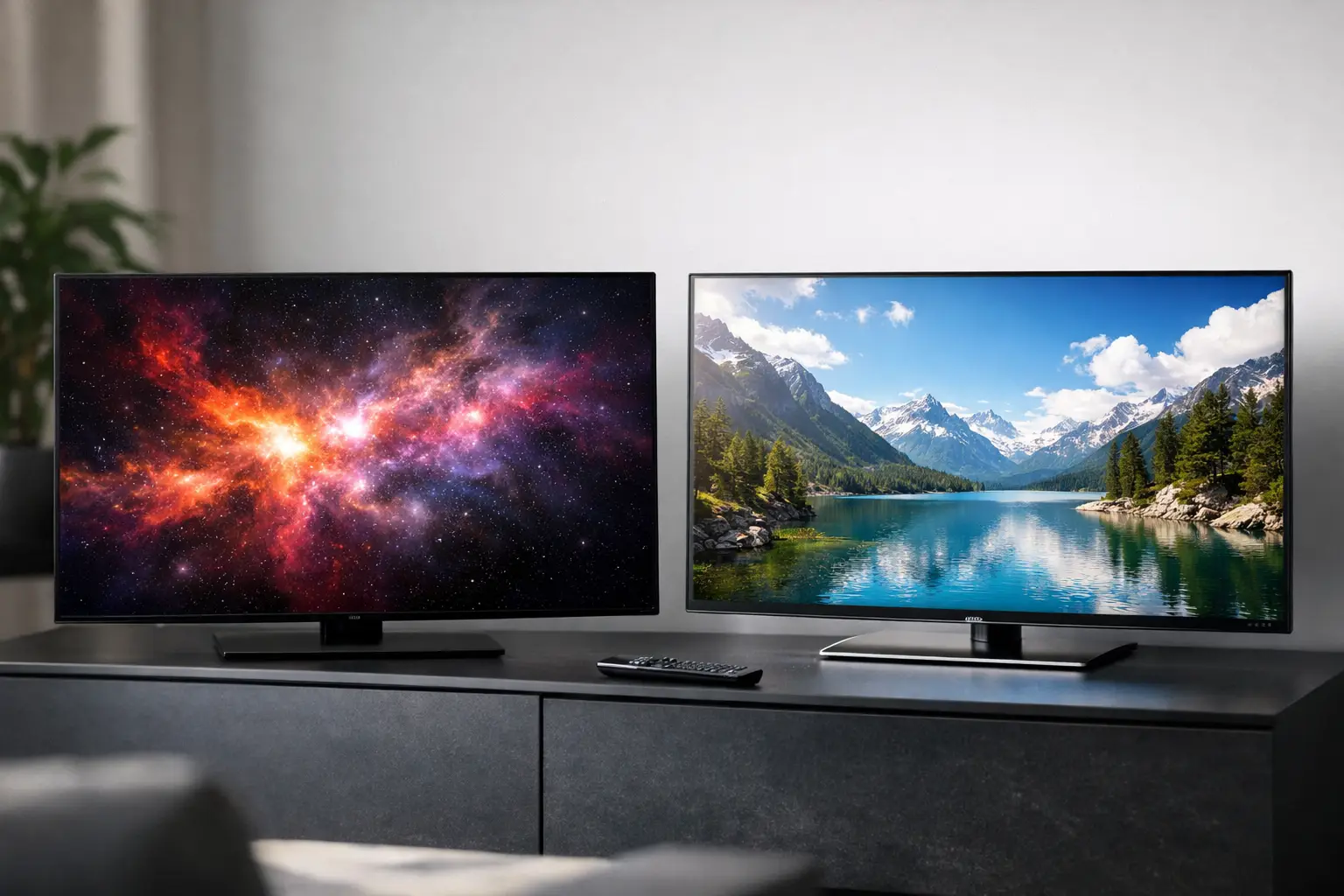
A great TV can make a rainy Sunday film marathon feel properly cinematic, but OLED vs QLED is not a simple case of one screen being better than the other. The right choice depends on where you watch, what you watch and how much you want to spend. An OLED may win you over in a dark living room, while a bright QLED can look more convincing during a sunlit Saturday afternoon.
The names are similar enough to cause confusion, yet the technologies work in very different ways. Here is what actually changes when you put them in your home.
OLED vs QLED: the key difference
OLED stands for Organic Light-Emitting Diode. Each pixel creates its own light and can switch off completely. That is why OLED televisions are known for true black levels, striking contrast and a picture that looks especially rich in dark scenes.
QLED stands for Quantum Dot LED. Despite the name, it is still an LCD television with an LED backlight. Quantum dots help it produce brighter, more vivid colours than traditional LED TVs. Many modern QLED sets also use Mini LED backlights, which pack in far more small lighting zones to improve contrast.
That distinction matters. An OLED controls light pixel by pixel. A QLED controls light behind an LCD panel, either across the whole screen or in zones. The better the dimming system, the closer a QLED can get to deep blacks – but it cannot fully match an OLED’s ability to turn individual pixels off.
Picture quality in films and box sets
If your main goal is film night, OLED is often the more immediately impressive option. A black scene in a thriller stays black rather than looking dark grey, while bright signs, candles and streetlights stand out with real depth. This can make streaming dramas and 4K Blu-rays feel more detailed, even when the TV’s stated resolution is the same.
OLED also tends to have very wide viewing angles. If the whole family is spread across the sofa, or someone is perched in the armchair at the side of the room, the image usually keeps its colour and contrast well.
QLED televisions can still look excellent, especially models with full-array local dimming or Mini LED. They often deliver punchy colour and can make high-impact scenes look bold. However, in a dark room you may occasionally spot blooming: a slight glow around bright objects such as subtitles, stars or a white logo against a black background. It is not always distracting, but once you notice it, it can be hard to ignore.
For viewers who regularly watch after dark, OLED has the edge. If most viewing happens with lamps on and curtains open, the gap becomes less obvious.
Bright rooms favour QLED
This is where QLED has a serious advantage. Brightness is useful for more than making colours pop. It helps the picture hold up against daylight, reflections from windows and overhead lighting. In a large open-plan room, a high-end QLED or Mini LED television can stay clearer and more forceful than an OLED.
OLED brightness has improved significantly, particularly on premium models, so the old idea that every OLED looks dim is out of date. Still, the brightest QLED sets usually have more power in reserve for vivid HDR highlights and daytime sports.
Think about your room before getting caught up in shop-floor demos. A television displayed under harsh retail lights is designed to grab attention. At home, a screen’s anti-reflection coating, placement and the direction of nearby windows can matter as much as its peak brightness figure.
Sport, gaming and everyday viewing
For sport, both technologies can deliver a sharp, enjoyable image, but a bright QLED is often the safer all-round pick for daytime matches. Football on a sunny afternoon, Formula 1 highlights and big summer tournaments can all benefit from the extra brightness. Some viewers also prefer QLED’s naturally punchy presentation for fast-moving sport.
Gamers have good options on either side. OLED’s near-instant pixel response produces exceptionally clean motion, with less blur around fast camera turns. Dark games can look spectacular, too, because shadows retain their depth without becoming washed out.
QLED televisions can be brilliant gaming screens as well, especially if they offer 4K at 120Hz, variable refresh rate and low input lag. Those are the features to check for on a PlayStation 5, Xbox Series X or gaming PC. Do not assume a costly screen has every gaming feature on every HDMI port.
There is one OLED caveat for serious gamers. Static elements such as health bars, maps and menus can remain in the same position for hours. Modern OLED TVs include pixel-shifting and panel-care features to reduce risk, and ordinary mixed use is unlikely to cause trouble. But if you leave one game, news channel or desktop screen running for long periods every day, QLED offers more peace of mind.
Price, size and value for money
OLED used to sit firmly at the premium end of the market. Prices have become more competitive, particularly around sales periods, but QLED still gives buyers a wider range of budgets and sizes. It is often easier to find a large QLED screen for the same money as a mid-sized OLED.
That can be the deciding factor. A 75-inch QLED may deliver a more dramatic upgrade from an older 50-inch television than moving to a smaller OLED. For a busy family room, size, brightness and value can be more useful than perfect black levels.
At the premium end, the comparison is tighter. Top OLEDs bring refined processing, excellent motion and class-leading contrast, while top Mini LED QLEDs combine serious brightness with strong local dimming. The badge alone is not enough: read the specifications for the exact model and avoid judging an entire technology by its cheapest television.
What to check before you buy
Panel type is only one part of the purchase. Look at the TV’s size in relation to your seating distance, then check whether it supports the HDR formats you use most. Dolby Vision is common across streaming services, although support varies by manufacturer. HDR10 and HLG are also relevant for standard HDR content and broadcast viewing.
Sound deserves attention too. Slim televisions rarely produce room-filling audio on their own, regardless of the screen technology. A soundbar can make dialogue clearer and give films more impact, but it should fit your room and budget rather than being treated as an automatic extra.
Also consider the operating system. You will use the home screen every day, so make sure the apps you want are available and that the menus feel straightforward. A beautiful panel is less enjoyable if finding iPlayer, Netflix or your usual sports service becomes a chore.
So, should you choose OLED or QLED?
Choose OLED if you watch lots of films and prestige TV in the evening, care about cinematic contrast, or want strong picture quality from every seat in the room. It is also a standout option for gaming, provided your use is varied and you do not routinely leave static images on screen for hours.
Choose QLED if your room gets plenty of daylight, you want the brightest possible image for sport, or your budget stretches further with a larger screen. A good Mini LED QLED is particularly compelling for households that watch a bit of everything at all times of day.
The best move is to picture the television in your actual room, not in a showroom. Buy the screen that suits how your household watches, then spend a little time adjusting its picture settings. That is where a good television starts looking like a great one.

